


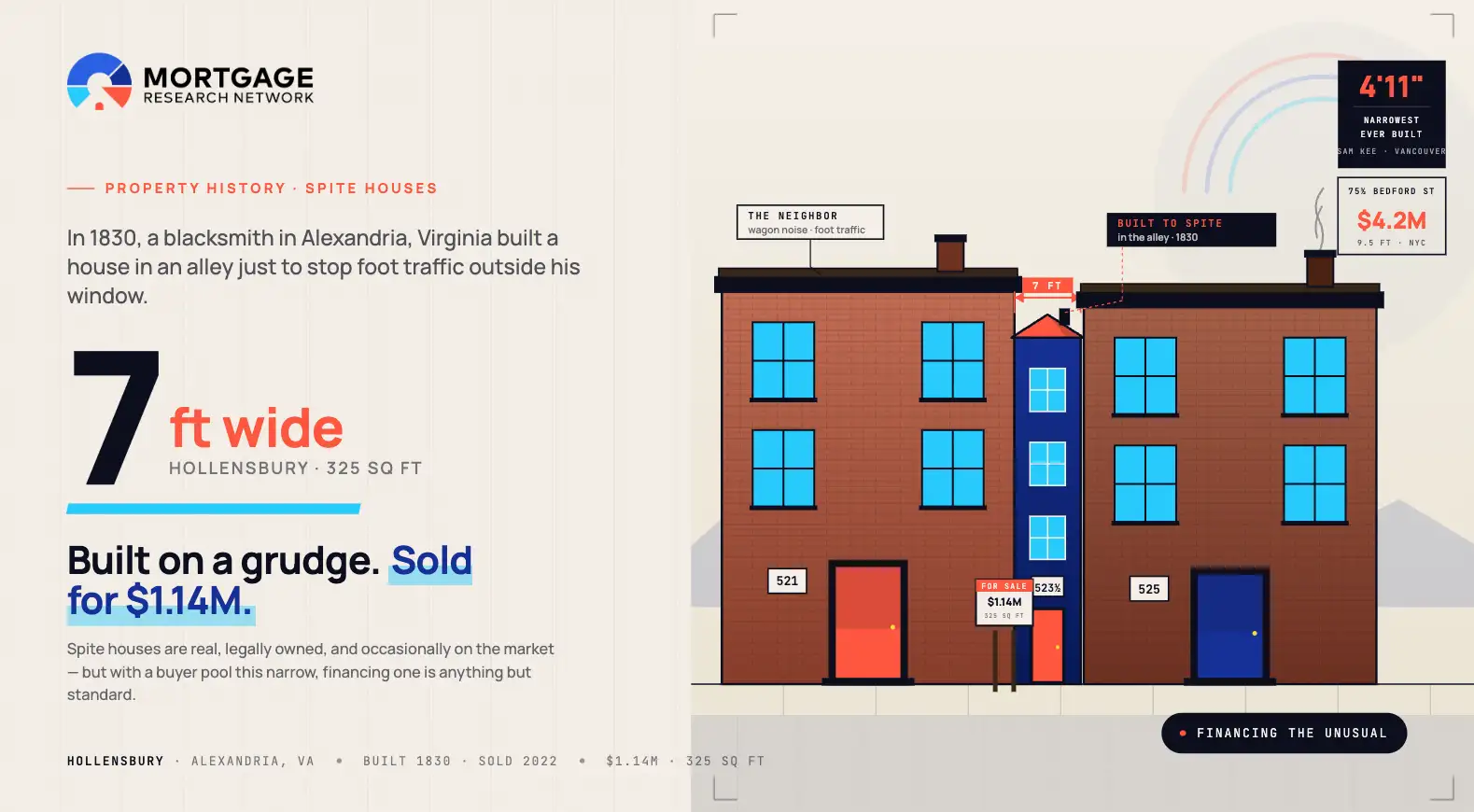
A spite house is a real building, legally owned, and occasionally for sale. These structures were built specifically to annoy a neighbor or block a view, and some of the most famous examples still stand today, including a 7-foot-wide townhouse in Alexandria, Virginia that sold for over a million dollars.
Most homes are built to be lived in. Spite houses are built to make a point.
A spite house is a structure erected primarily to irritate a neighbor, block light or a view, or retaliate after a property dispute. They're not a myth or an urban legend. They show up in deed records, real estate listings, and local historic registries across the country.
A History of Pettiness
The concept dates back centuries, but American spite houses flourished in the 1800s and early 1900s, when property rights were hotly contested and legal remedies were slow. When a neighbor refused to buy out a small strip of land, the owner could sometimes build on it rather than sell, producing structures so narrow they appear structurally impossible from the street.
One of the oldest surviving examples is the Hollensbury Spite House in Alexandria, Virginia. Built in 1830, it is 7 feet wide and 325 square feet total. A blacksmith named John Hollensbury built it in an alley gap specifically to stop foot traffic and wagon noise outside his home. It remained a private residence for nearly two centuries and sold in 2022 for $1.14 million.
The Narrowest Addresses in America
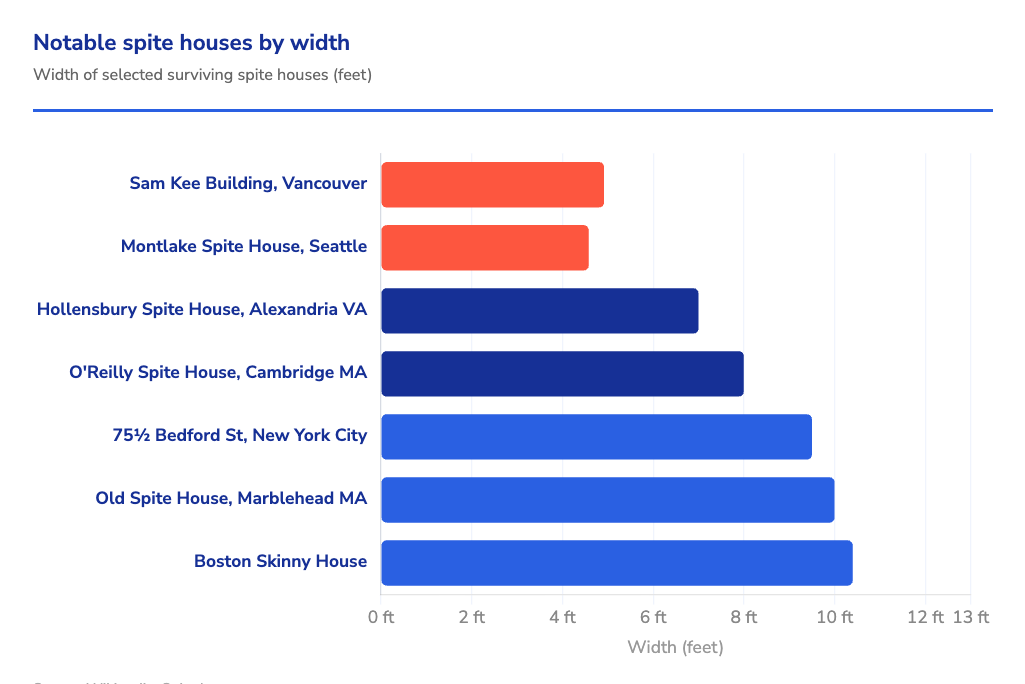
Width is the defining feature of a spite house. These are some of the most notable surviving examples, with dimensions documented by historians and local records:
Hollensbury Spite House, Alexandria, VA: 7 ft wide, 325 sq ft (built 1830, sold $1.14M in 2022)
O'Reilly Spite House, Cambridge, MA: 8 ft wide (built 1908, still standing)
75½ Bedford Street, New York City: 9.5 ft wide (most recently listed around $4.2–5M)
Old Spite House, Marblehead, MA: 10 ft wide (built 1716, one of the oldest in the country)
Boston Skinny House: 10.4 ft wide (sold for $1.25M in 2021)
Montlake Spite House, Seattle, WA: 55 inches at its narrowest point (built 1925, sold $745K in 2025)
Sam Kee Building, Vancouver, BC: 4 ft 11 in wide (built 1913, listed in the Guinness World Records)
What Happens When One Goes on the Market
Spite houses attract buyers the same way they attracted builders: through sheer novelty. They tend to move quickly when listed, drawing both investors and buyers who want a piece of genuine local history.
But financing one is not always straightforward. Lenders evaluate properties on livability, marketability, and comparable sales. A 7-foot-wide home has a very limited buyer pool by definition, which can affect appraisals and loan-to-value ratios. Some lenders will decline to finance unusual properties outright if they can't find sufficient comps in the area.
Title searches matter more than usual here too. Many spite houses sit on strips of land that were disputed, subdivided, or subject to easements. A thorough title review before making an offer is not optional.
The Broader Point
Spite houses are extreme examples of something that comes up regularly in real estate: neighbors with competing interests over adjacent land. Disputes over easements, view corridors, light, and access shape property values in ways most buyers never notice until they're in the middle of one.
The spite house is just what happens in a high-stakes game of real estate chicken where no one yields.