


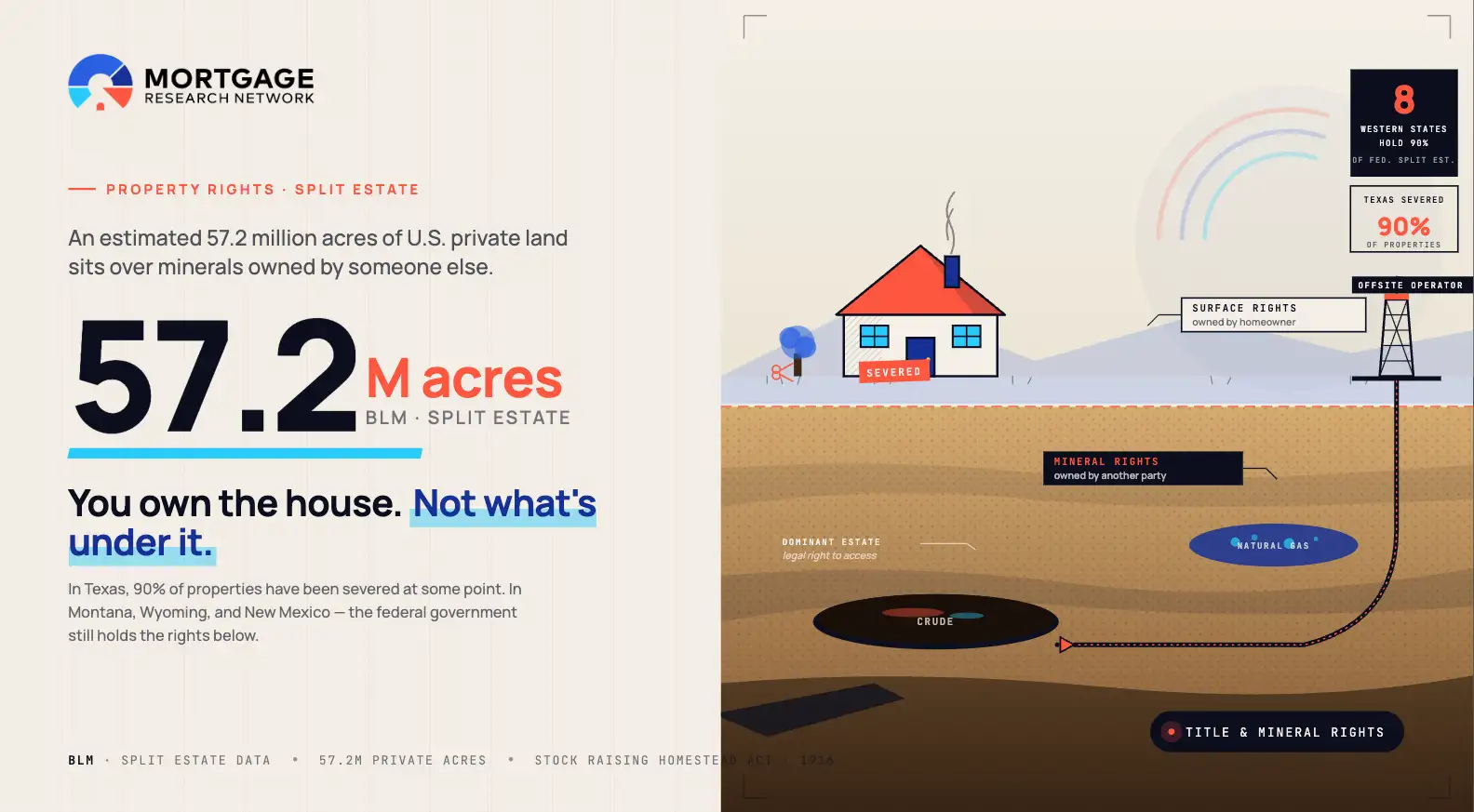
A split estate means the surface rights and mineral rights to a property are owned separately. Millions of homeowners in the western U.S. don't own the minerals beneath their land, and the party that does may have the legal right to show up and drill.
Buying a home comes with a long list of things to worry about: the roof, the foundation, the neighborhood. Most buyers never think to ask about what's underground.
They probably should.
In many parts of the country, especially across the western United States, the mineral rights to a property can be owned by an entirely different party than the homeowner. This situation is called a split estate, and it affects an estimated 57.2 million acres of private land in the U.S., according to the Bureau of Land Management (BLM).
What Is a Split Estate?
A split estate exists when the surface rights and the mineral rights to a parcel of land have been legally separated. You own the top. Someone else owns what's underneath, including oil, gas, coal, and other minerals.
This isn't just a technicality. In the legal hierarchy of property rights, mineral rights are considered "dominant." That means the mineral rights holder has the legal right to access the surface in order to explore and extract what belongs to them. The surface owner cannot stop them, as long as the access is considered "reasonable."
Some leases even prohibit the surface owner from building, landscaping, or digging over certain portions of the property.
How Did This Happen?
Much of the split estate problem traces back to the Stock Raising Homestead Act of 1916. The law allowed settlers to claim up to 640 acres of non-irrigable land for farming and ranching. But as mineral exploration ramped up, the federal government quietly held onto the underground rights for lands patented under this act.
Those original reservations are still in effect. If you buy land in Montana, Wyoming, or New Mexico today, the minerals beneath it may still belong to the U.S. government.
Private severance is also common. When a landowner sells property, they can choose to retain the mineral rights. That reservation passes with the land indefinitely. In oil-rich states like Texas, the mineral rights on over 90% of properties have been severed from the surface rights at some point.
Which States Are Most Affected?
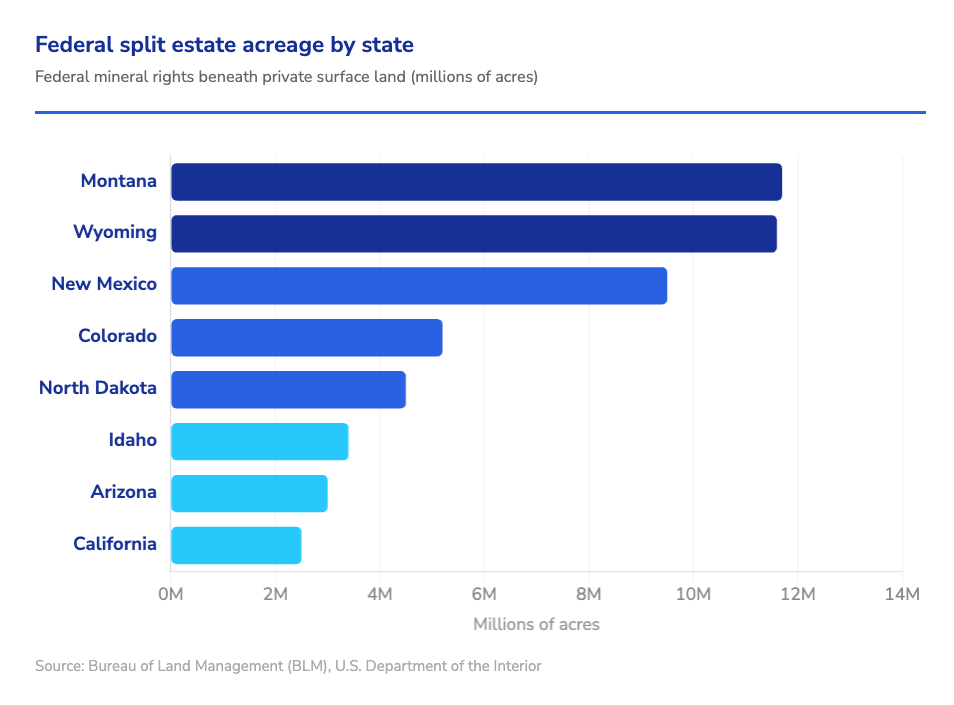
The BLM estimates that 90% of federal split estate acreage falls in just eight western states:
Montana: 11.7 million acres
Wyoming: 11.6 million acres
New Mexico: 9.5 million acres
Colorado: 5.2 million acres
North Dakota: 4.5 million acres
Idaho: 3.4 million acres
Arizona: 3.0 million acres
California: 2.5 million acres
Beyond federal split estates, private severances are widespread across Texas, Oklahoma, Pennsylvania, Louisiana, West Virginia, and other states with histories of oil, gas, or coal extraction.
What It Means for Your Mortgage
This is where split estates can get complicated for homebuyers.
When a lender reviews the title commitment on a property, a mineral rights exception may show up. At that point, the lender has to decide whether to proceed. Fannie Mae allows outstanding oil, water, or mineral rights as a title exception, but only if they are "customarily waived by other lenders" and do not "materially alter the contour of the property or impair its value or usefulness."
Active or pending drilling operations near the property can make lenders and insurers nervous. In those cases, approval may be difficult or come with conditions.
Severed mineral interests can also affect appraised value, since they limit what the surface owner controls and may reduce the number of potential buyers.
How Often Does Someone Actually Show Up?
This is the question most homeowners want answered, and the honest answer is: for most people, probably never.
The BLM approved roughly 6,100 drilling permits across all federal and Indian lands in fiscal year 2025. Spread across 57 million split estate acres, that's a very small fraction of affected properties seeing any drilling activity in a given year. And many permits that are approved never result in a well being drilled at all. Industry sources note it's common for mineral ownership to be leased multiple times over many years without a single well ever going in.
Drilling decisions are driven by geology and economics, not just land ownership. If the minerals beneath a particular property aren't economically viable to extract, no company is going to bother.
There's also a modern wrinkle worth knowing: most oil and gas wells today are drilled directionally. A well pad located a mile or two away can reach minerals beneath your property underground without any surface access to your land at all. In those cases, the surface owner may never even know drilling is happening nearby.
That said, the risk is not zero, and it is concentrated in specific places. Litigation involving surface owners and mineral operators has been rising, particularly in active drilling basins like Wyoming's Powder River Basin, the Permian Basin in New Mexico, and the Williston Basin in North Dakota. In suburban and exurban areas where residential development has expanded into historically rural energy-producing regions, conflicts are more common.
When access is legitimately needed, the operator is required to provide advance notice and negotiate a surface use agreement. They must also post a bond to cover any surface damage. They can't simply arrive unannounced with equipment. But the legal framework still ultimately favors the mineral rights holder if negotiations break down.
The bottom line on risk: if you're buying a home in a city or suburb, a severed mineral estate is mostly a title and appraisal concern, not a practical one. If you're buying rural property in an active energy basin, it deserves serious due diligence.
How to Find Out What You Own
The good news is that mineral ownership is a matter of public record. Before closing on a property, especially in affected states, a buyer should:
Request a title search that specifically checks for mineral rights severances
Review the original land patent to identify which Homestead Act the parcel was issued under
Contact the local BLM office if federal mineral ownership is suspected
Ask the seller to disclose any existing mineral leases
Your real estate attorney or title company can help interpret what's in the records. In states where severance is common, this step should be standard practice, not an afterthought.