



Rising inventory, falling interest rates, and lower prices in many real estate markets are shaping up 2026 to be a promising year for first-time homebuyers.
The past few years have been challenging for prospective first-time buyers: record home prices, high interest rates, and a shortage of properties hitting the market.
But now, conditions are changing, and things are starting to look up for those seeking to make homeownership a reality. Let’s take a deeper look at why 2026 may shape up to be an excellent year for first-time homebuyers.
What’s Happening in the Housing Market?
It’s impossible to say with complete certainty what’s going to happen with the housing market as we move further into 2026. As of now, however, the signs look promising for first-time homebuyers.
We’re already seeing a greater selection of properties hitting the market as the need to sell is outweighing some homeowners’ desire to hold onto their ultra-low interest rates. In turn, this increased supply and reduced demand are causing home prices to fall in some markets.
On top of that, mortgage rates are among the lowest they’ve been since 2022 and are currently trending downwards.
All in all, these conditions may be creating the perfect opportunity for hopeful homebuyers looking to enter the market in 2026.
More Homes Are Being Listed
Active home listings hit a record low of under 350,000 in February 2022. This severe shortage of available properties made it difficult for buyers, as desirable residences were often bid up well above their asking price as soon as they hit the market.
Since then, however, listings have steadily increased. From May until November 2025, the most recent data available, the Federal Reserve has reported more than one million active listings each month. As of this past November, there are more than three times as many homes for sale as there were back in early 2022.
In addition, the number of active listings jumped year-over-year from around 952,000 in November 2024 to more than 1,072,000 in November 2025 – a rise of 12.6%.
The good news for 2026? We’re expected to see inventory increase by another 8.9%, according to projections by the National Association of Realtors (NAR).
For first-time homebuyers, this hopefully means more properties to choose from, fewer bidding wars, and more power in negotiations.
Don’t Forget About New Construction
Despite new-home construction falling slightly in 2025 due to waning demand and other economic factors, NAR's 2026 forecast anticipates residential construction to increase by 3.1%, translating into a total of 1 million new homes hitting the market during the year.
In some cases, builder incentives may even make new homes cheaper than existing properties – particularly in rapidly growing communities – providing another excellent opportunity for first-time buyers.
Home Prices Are Falling (in Some Markets)
Because more properties are being listed for sale and buyer demand has decreased from its pandemic-era high, we’ve seen home prices fall nationally. However, this can vary significantly from market to market.
Across the board, the most recent data released by the Federal Reserve shows that the nationwide median sales price fell to $410,800 in the second quarter of 2025. In the fourth quarter of 2022, that figure stood at $442,600.
Keep in mind, however, that property values aren’t dropping everywhere. Prices have held firm, and even increased, throughout much of the Northeast and Midwest. However, destinations that were in demand just a few years ago – such as Florida and Texas – have seen significant declines.
For example, Newsweek reports that home values in Austin, TX, have fallen by 20.5% from their recent peak. Similarly, prices in Tampa, FL, have dropped by 12%. Many experts predict that certain locales will continue to experience this price correction in 2026, although likely at a slower pace than seen over the past couple of years.
Overall, third-quarter data released by the National Association of Realtors show that prices have risen – albeit often marginally – in 77% of the country’s major metro areas. For first-time buyers looking to purchase in the other 23%, however, 2026 may present a great opportunity.

Interest Rates Continue to Drop
While we’re unlikely to see the ultra-low interest rates of the early 2020s anytime soon, rates have steadily decreased from their 2023 high.
After 30-year fixed-rate mortgages reached an average of 7.79% in October 2023, they had retreated below 6.25% by the end of 2025, according to Freddie Mac’s Primary Mortgage Market Survey.
That drop certainly helps first-time homebuyers, but the good news doesn’t end there. The Federal Reserve is expected to cut the federal funds rate even further in 2026, and Fannie Mae’s Economic and Strategic Research Group anticipates 30-year mortgage rates to fall to 5.9% by the end of the year.
How Interest Rates Impact Mortgage Costs
What does this decrease mean in practical terms for a first-time buyer? Let’s take a quick look at how various rates can impact the monthly payment and lifetime interest costs on a $400,000 30-year mortgage.
| Interest Rate | Monthly Payment (P&I) | Total Interest Costs |
|---|---|---|
| 8.00% | $2,935 | $656,621 |
| 7.75% | $2,866 | $631,633 |
| 7.50% | $2,797 | $606,869 |
| 7.25% | $2,729 | $582,334 |
| 7.00% | $2,661 | $558,036 |
| 6.75% | $2,594 | $533,981 |
| 6.50% | $2,528 | $510,178 |
| 6.25% | $2,463 | $486,633 |
| 6.00% | $2,398 | $463,353 |
| 5.75% | $2,334 | $440,345 |
| 5.50% | $2,271 | $417,616 |
The difference between a rate of 7.75% and 6.25% – roughly the decrease between late 2023 and late 2025 – is a monthly savings of more than $400 and a whopping $145,000 in interest payments saved over the life of the loan in this example.
If rates keep falling as predicted in 2026, mortgages will continue to become even more affordable for first-time buyers.
Preparing to Buy Your First Home
It looks like 2026 could be shaping up to be the best year we’ve seen in a while for first-time buyers. If you think that homeownership may be in the cards at some point this year, it’s crucial that you begin preparing as soon as possible.
1. Review Your Credit and Finances
Even though Fannie Mae recently removed its minimum credit score requirement, higher scores still equate to lower interest rates.
By planning ahead and taking steps to improve your credit, you can maximize the chances of qualifying for a more favorable rate and reducing your housing costs. In most cases, you can secure the best loan terms with a score of 760 or higher.
You’ll also want to take a look at your existing monthly debt obligations – things like car payments and credit card minimums – and try to reduce them as much as possible.
Lenders typically want borrowers to have a debt-to-income (DTI) ratio of 43% or lower, meaning your monthly debts, including the mortgage you’re applying for, should account for no more than 43% of your total qualifying income.
2. Save for a Down Payment and Closing Costs
Taking out a conventional loan typically requires a down payment of 5% of the home’s purchase price. As a first-time homebuyer, however, you may be able to qualify with just 3% down. Even still, that can be a significant amount to save with today’s home values.
But it’s not just about the down payment: many first-time buyers don’t realize that they’ll also need to pay for closing costs – the fees and expenses associated with buying a home and taking out a mortgage – which can typically run between 2% and 6% of the total amount financed.
Altogether, you may need to have anywhere from 5% to 11% of your purchase price available when you close, making it crucial that you start planning for this upfront expense well ahead of when you intend to buy.
3. Understand Your Mortgage Options
Mortgages come in all shapes and sizes. From the standard 5% down loan to 3% down options for first-time homebuyers, conventional lenders offer an assortment of ways to finance your home purchase.
Plus, there are several government-insured programs, backed by agencies like the FHA, VA, and USDA, that may be a more practical option for buying your first home, depending on your individual situation and unique borrowing needs.
4. Get Pre-Approved for a Loan
Perhaps the most critical thing you can do when preparing to purchase a home is to talk with a mortgage company and get pre-approved for a loan. Mortgage pre-approval involves a lender checking your credit, verifying your income, and giving you a solid idea of the price point you can actually afford.
5. Find an Experienced Real Estate Professional
Once you have a pre-approval letter in hand, you’re in a good position to get serious about your home search. While looking online can help acclimate you to the local housing market, you’ll want to get in touch with an experienced real estate professional who can help you navigate the intricacies of purchasing your first home.
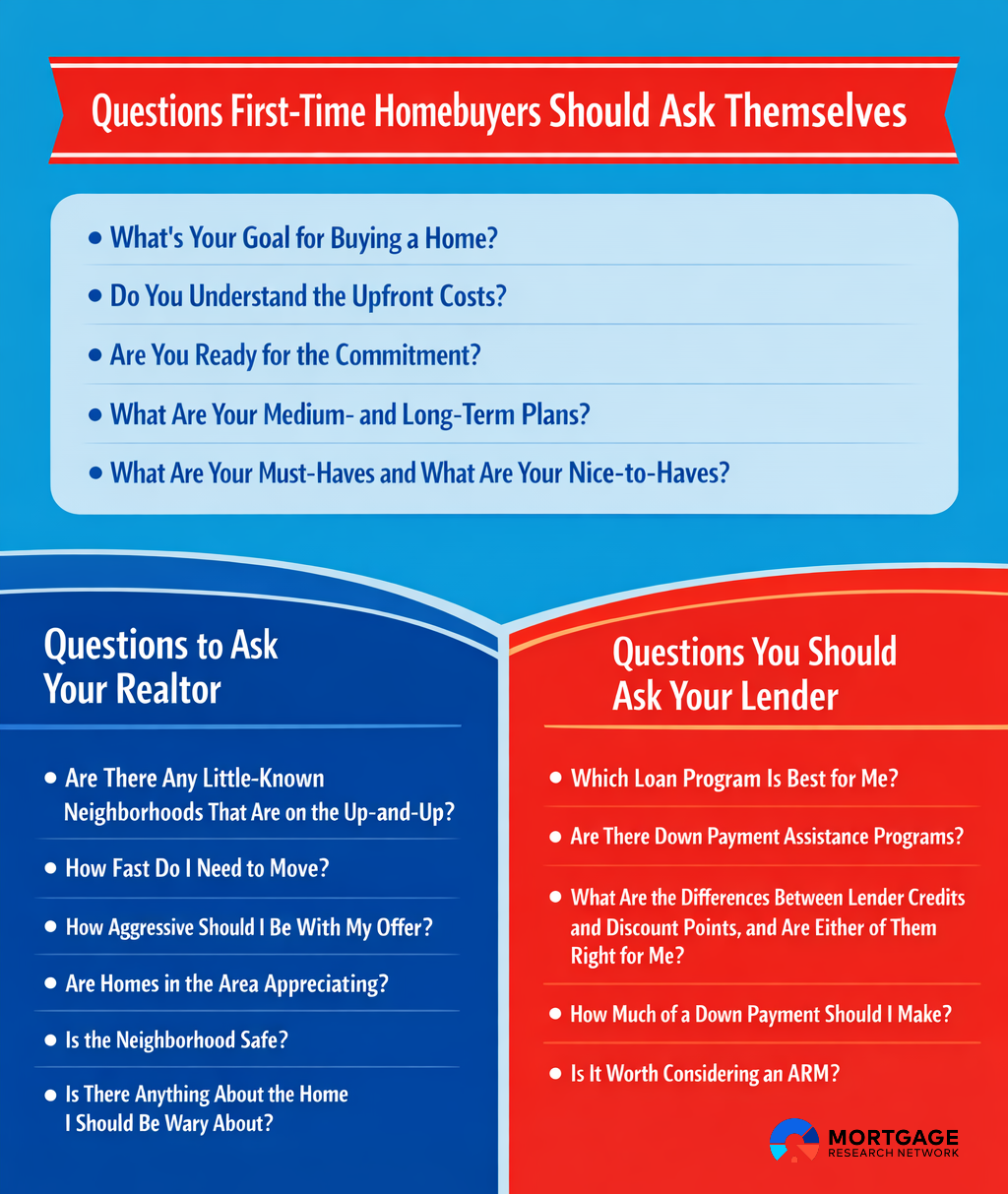
Opportunities for First-Time Homebuyers
As a first-time homebuyer, there are a variety of resources that can make your dream of homeownership far more attainable. From free homebuyer education courses to down payment assistance programs and even special mortgage options, taking advantage of these opportunities will greatly simplify the homebuying experience.
First-Time Homebuyer Education Courses
Homebuyer education courses can be a valuable resource for first-time buyers, helping them understand the homebuying process and the factors that can impact it.
First-time homebuyer education courses will typically cover topics such as:
The impact of credit when buying a home
Effective tips for saving for a down payment
The process of obtaining a mortgage
Best practices when shopping for a home
What to expect when closing
Important things to know as a new homeowner
While there are a variety of homebuyer education options out there, two of the most popular are the Fannie Mae HomeView program and Freddie Mac’s CreditSmart.
Down Payment Assistance Programs
Unsure how you’re going to raise the funds for a down payment? Down payment assistance is available across the country, typically at the state, county, and city levels. Some of these programs are offered by governmental agencies, while others are available through localized nonprofits.
Down payment assistance can come in a variety of forms, including grants and loans that are forgiven after a set period of homeownership. In many cases, you can also use these funds to cover your closing expenses.
Mortgage Programs for First-Time Buyers
As we touched on earlier, borrowers typically need a 5% down payment to qualify for a conventional loan. However, there are special programs designed specifically for first-time homebuyers that require only 3% down. On a $400,000 mortgage, this could alleviate your upfront burden by $8,000.
Popular first-time homebuyer programs include:
Plus, while not exclusively limited to first-timers, there are some government-backed loan programs that can help make homeownership more affordable:
FHA Loans: Homebuyers with less-than-stellar credit can qualify for a 3.5% down FHA loan with a score of just 580.
VA Loans: Available to veterans and active-duty service members, VA loans allow you to buy with 0% down and some of the most favorable rates on the market.
USDA Loans: Purchasing a property in a designated rural community? You may be able to obtain a USDA loan with an attractive interest rate, no down payment, and low upfront and annual fees.
Tips for Buying a Home in 2026
Ready to make the leap into homeownership in 2026? Here are some actionable tips to maximize your chances of success and secure the best deal possible on your first home:
You gain a lot of negotiation power in markets that favor buyers. While this can apply to the purchase price, it could also mean negotiating concessions, such as asking the seller to pay a portion of your closing costs, thereby reducing the amount of cash you’ll need to close.
Properties that need a little bit of work tend to offer great value. Consider a fixer-upper if you want the best bang for your buck, and ask your lender about renovation loans that may help you finance the repairs.
Sometimes, though, newly constructed residences can be available at costs lower than existing homes. This is particularly true in rapidly growing markets where builders have a large surplus of completed properties and are offering incentives to move them quickly.
Understand your limitations and don’t rush in. Buying your first home is exciting, but overextending yourself financially to do so can leave you in a bind. Be realistic about what you can afford and make the effort to improve your borrower profile to secure favorable loan terms and enhance your long-term financial well-being.
Is 2026 the Right Time to Buy Your First Home?
While property values and interest rates have priced many prospective first-time buyers out of the market in recent years, conditions are improving.
Although anything can still happen as we progress through 2026, it’s likely that the supply of homes will continue to increase, prices will stay relatively steady or even decrease in some areas, and interest rates will drop even further.
If you’re thinking about buying a home this year, now is the time to get in touch with a mortgage professional to discuss your individual financing needs and the most effective strategies to achieve your homeownership goals.