



A homeowners association (HOA) is a private organization that manages shared spaces, enforces community rules, and collects fees from residents in developments like condos, townhomes, and planned single-family neighborhoods.
Interested in purchasing a condo, townhome, or detached home in a gated community? Chances are, your property will fall under the umbrella of a homeowners association (HOA). This is a private group that governs a residential community. HOAs set and enforce rules that community residents must follow and collect fees for services and maintenance of common areas.
What is an HOA?
An HOA is a nonprofit organization, association, or corporation that governs a planned community or building with shared property. The HOA collects fees from homeowners within the community and uses the dollars to pay for items like common area upkeep, improvements, and amenities.
HOAs are common in developments that offer condominiums, townhomes, or other types of homes where shared amenities like landscaping, pools, and security are provided.
HOAs exist to maintain community standards, safeguard property values, and manage shared spaces. The HOA ensures that its rules are followed to maintain harmony and consistent aesthetics within the community.
“You’ll most often see HOA in single-family subdivisions, townhouse communities, and condominium or co-op buildings,” notes Steven Glick, director of mortgage sales for HomeAbroad. “Roughly 369,000 community associations serve about 77 million residents across the nation, so these communities are common in both suburbs and cities.”
How HOAs Work
HOAs are private organizations, so each one is different. They are typically formed by residents and enforced with covenants attached to the properties within that community. This requires any current and future homeowners to abide by the HOA rules.
“Generally speaking, HOAs have a democratic structure where members elect a board to create and enforce rules,” explains Martin Orefice, CEO of Rent To Own Labs. He notes that an HOA usually is governed by the builder/developer until most of the properties within the community are sold, after which time an elected board runs the HOA.
“HOA rules usually focus on community-facing elements of properties. They have lots to say about landscaping, exterior finishes, large gatherings, parking, where to put your trash cans, pets, and more. Penalties for rule violations are usually in the form of fines paid to the HOA, but legal action is possible in some situations,” continues Orefice.
According to attorney Elizabeth Whitman, HOAs are established by recording legal documents in the county real estate records. These documents describe the HOA’s governance, homeowner fees, and covenants, conditions, and restrictions (CC&Rs) applicable to homeowners.
“An HOA generally has only as much power as it is given in the CC&Rs and other recorded documents. The scope of the HOA’s authority will depend in part on the community and its amenities,” states Whitman.
Homeowners are responsible for paying HOA assessments and complying with the CC&Rs and any rules adopted by the board. They must also maintain their lot and unit as required, follow use and architectural rules regarding things like parking, pets, and exterior changes, and comply with insurance requirements where applicable.
“Those who don’t pay their assessments will have a lien placed on their property, which the HOA could foreclose,” cautions Whitman. “Those who violate other CC&Rs requirements or rules will be cited for the violation and asked to correct it. If you do not comply, the HOA may correct the violation itself and charge you for the cost involved or could bring a lawsuit to enforce the CC&Rs or rule.”
HOA Fees and What They Cover
HOA fees can vary widely based on your location and amenities.
“A small HOA neighborhood might charge $50 a month for basic maintenance, while a luxury or condo community can exceed several hundred dollars monthly,” says Zev Freidus, president of ZFC Real Estate.
Consider that nearly one quarter of American homeowners paid condo or HOA fees in 2024, with approximately 3 million households paying $500 or more every month, per Glick.
These assessments commonly cover things like exterior and common-area maintenance (landscaping, snow and leaf removal, and swimming pools), utilities for common areas, master insurance on shared structures or property, and management and reserves for big projects like a new roof or repaved parking lot.
Pros and Cons of Living in an HOA
Let’s take a closer look at the advantages and disadvantages of purchasing and living in a community governed by an HOA.
| Pros | Cons |
|---|---|
| Landscaping, lighting, and shared spaces stay consistently maintained without you having to organize vendors. | Expect guidelines on paint colors, parking, pets, rentals, and exterior improvements that can feel limiting for some homeowners. |
| Uniform standards often help preserve neighborhood aesthetics and resale value. | Unexpected expenses, like roof or pool repairs, can lead to one-time fees on top of monthly dues. |
| Pools, parks, gyms, and clubhouses add convenience and a sense of community without individual upkeep. | Insurance hikes, inflation, or new state laws (like Florida’s condo reserve requirements) can cause dues to climb. |
| Owners vote on key issues and budgets, allowing residents to have a say in community direction. | Volunteer boards vary in experience; poor management can lead to financial or neighbor disputes. |
| Routine maintenance and reserve planning can reduce surprises compared to non-HOA neighborhoods. | Late dues or rule violations can trigger fines, suspension of privileges, or, in severe cases, liens and foreclosure. |
| Events, committees, and shared spaces can build a stronger sense of neighborhood connection. | Even small personal decisions like holiday décor or mailbox type may require board approval. |
Questions to Ask Before Buying in an HOA Neighborhood
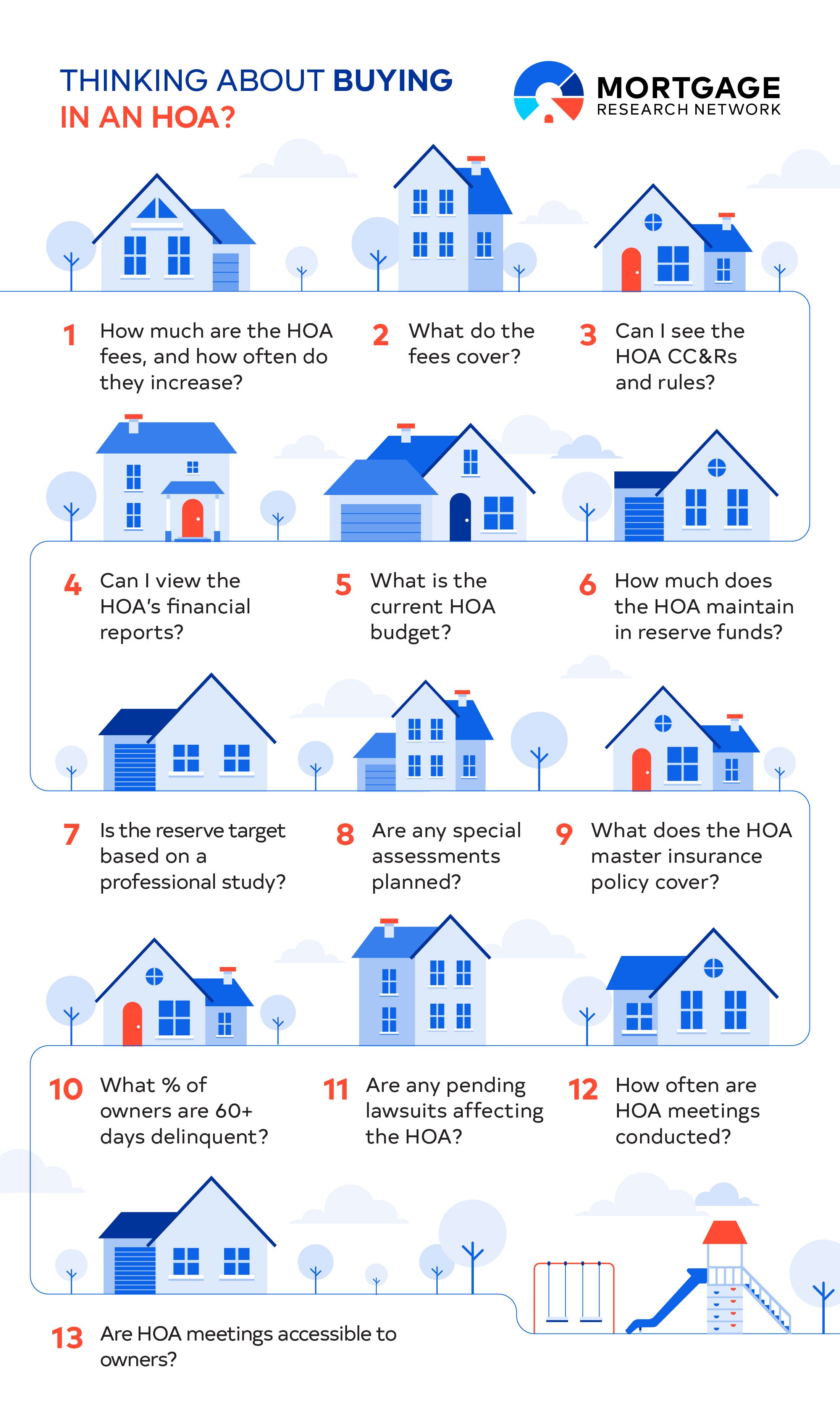
Here’s a roundup of inquiries you should make before committing to a purchase within an HOA community:
How much are the HOA fees, what do they cover, and how often do the fees increase?
Can I see the HOA CC&Rs and rules? This way, you understand what your obligations are after purchasing. Keep in mind that CC&Rs are public records that your title company can obtain a copy of, but community rules are private.
Can I view the HOA’s financial reports? “It’s important to understand whether the HOA is sufficiently funded and has cash reserves to pay for large capital expenses,” says Whitman. “If the HOA is struggling financially, your assessments may need to be increased significantly. HOAs may be reluctant to share financial records, but the selling homeowner usually has a right to receive them and should be able to provide these records to you when you purchase.”
What is the HOA budget and reserves? “Ask if reserves are set by a study and what the current reserve balance is. And ask if any special assessments are planned in the next few years,” recommends Glick.
What does the master insurance policy cover versus what I must insure myself?
What percentage of owners are delinquent for more than 60 days?
Are any pending lawsuits affecting the board, building, or community?
How often are HOA meetings conducted?
Are HOA meetings accessible to owners?
HOA vs Non-HOA Communities
An HOA is different from other types of similar organizations, including community associations and property owner associations.
“An HOA is a type of property owner association. But the term ‘property owner’ is more commonly used for an association in a mixed-use community that includes non-residential properties – such as retail stores or apartment communities – as well as single-family residences. The term ‘HOA’ is typically used when all of the properties governed by the association are residential properties,” notes Whitman.
A community association, on the other hand, is a membership group where the membership is voluntary. These groups do not have the right to dictate community maintenance or repair standards. However, they can help negotiate discounted trash, snow removal, and other services for members.
“Community associations can also use member dues to maintain common areas or provide community events,” says Whitman, who adds that community association dues are generally much lower (often less than $100 annually) than HOA fees.
Technically, a condominium association is a type of HOA, but there are some differences.
“In a condominium association, you own your unit’s airspace. The association owns and maintains the building shell and common systems,” Glick says. “Condominium association fees tend to be higher on average because the association must insure, maintain, and reserve funds for structure and systems. Also, amenities in that building can be more costly.”

Condominium association fees tend to be higher on average because the association must insure, maintain, and reserve funds for structure and systems. Also, amenities in that building can be more costly.
Legal Issues to Be Aware Of
Your rights as a homeowner in an HOA can vary depending on your state. Usually, you have the right either under state law or the CC&Rs to attend homeowner meetings, elect the HOA board, adopt and obtain copies of HOA records bylaws, and obtain copies of HOA records – such as financial records, bylaws, board minutes, and maintenance and capital expense reports and plans.
“You also have the right to written notice of violations and a process by which you can appeal violation notices when you disagree,” Whitman points out. “The HOA must provide a written decision after the appeal. If you disagree with that decision, you usually can file a lawsuit against the HOA. But some CC&Rs or bylaws may require mediation before a lawsuit can be filed or may require arbitration.”
In the event of a dispute, it’s often best to begin with the HOA board or manager and request an internal hearing as allowed.
“Many states encourage or require mediation or alternative dispute resolution before a lawsuit can be filed,” says Glick.
As mentioned earlier, if you fail to pay your assessments and other fees or fines required by the CC&Rs, the HOA can place a lien on your property.
“That lien can be foreclosed in the same way that a mortgage can be foreclosed via a court process if you don’t make your mortgage payments. Typically, you will receive notices and an opportunity to make payment,” says Whitman. “If you don’t pay, you could lose your property in a foreclosure sale.”
Is an HOA Right for You?
Living in an HOA has its pros and cons. The good news is that your neighborhood and/or building should look well-maintained, and you should enjoy stable property values. The downside is that you will have to abide by rules and restrictions and pay fines or suffer repercussions if you violate them.
Perform thorough due diligence before committing to a purchase within an HOA community. Consult closely with your real estate agent, lender, and attorney to make a more informed decision.