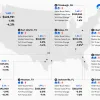



"The spring housing market began on a stronger footing, buoyed by improved affordability and slowly rebuilding inventory, despite the recent uptick in interest rates," found the ICE April 2026 Mortgage Monitor report from Intercontinental Exchange.
"Income Growth Outpacing Home Price Gains"
Fortune magazine concurred earlier this month: "Mortgage rates have ticked down modestly from their peak, and affordability has improved for eight consecutive months, supported by income growth outpacing home price gains," wrote Jessica Lautz, deputy chief economist and vice president of research at the National Association of REALTORS® in the magazine on Apr. 8. "What’s changing now isn’t demand, it’s that buyers and sellers may finally be able to meet in the middle."
True, mortgage rates have been ticking up again over the last six weeks as disruption in the Middle East has fueled higher inflation. But Lautz was probably thinking of the 7.04% rate seen on Jan 15, 2025, 6.89% last spring, and 6.75% last summer.
All those figures are weekly averages from Freddie Mac for 30-year fixed-rate mortgages. On Apr. 8, the latest figure available at the time this was written, the same average was 6.37%.
Yes, home buyers may kick themselves for missing out on the recent low of 5.98% on Feb. 25, immediately before the current uptick began. But those taking a longer view know they're still looking at a bargain.
Real Estate Agents Are Still Hesitant
CNBC published its latest Housing Market Survey of real estate agents on Apr. 7. And it found that these professionals were less upbeat about the spring housing market than either ICE or Fortune.
When asked, "What are your buyers most concerned about right now?" agents in the first quarter of this year identified:
- The economy — 34%, up from 32% the previous quarter
- Mortgage rates — 33%, up from 26% the previous quarter
- Inventory — 24%, unchanged from the previous quarter
- Home prices — 9%, half the previous quarter's 18%
“They’re fearful of the war, they’re fearful of gas prices, [for] their job security,” Las Vegas agent Faith Harmer told CNBC.
Not All Gloom for Agents
Those figures might make real estate agents sound more pessimistic than they actually are. When asked, "What is your expectation for sales in your market in the next quarter?" more than half (53%) expected an improvement, and 44% thought things would stay much the same. That leaves only about 3% who are expecting sales to decline this spring.
Indeed, those expectations are better than we would have thought. Everyone knows that the residential property market is notoriously varied geographically.
And some regions, states, cities and counties can have booming markets at the same time others are in sharp decline. That only 3% of agents nationwide expect a worse market this spring is remarkable.
The Risk Factor
The big unknown at the moment is how long the Middle East crisis will last. The longer it goes on, the higher gas and diesel prices are likely to go.
In the longer term, shortages in essential ingredients for fertilizers may push up food prices, while much of the world's helium passes through the Strait of Hormuz. Even more important than helium's role in creating funny voices at parties is its necessity to the production of sophisticated computer chips.
There is a risk of these pressures building into a significant bout of inflation. The March consumer price index, published last Friday, already shows the disruption is having an effect. The official Bureau of Labor Statistics report says:
The all items index rose 3.3 percent for the 12 months ending March, after rising 2.4 percent for the 12 months ending February.
Fears of sustained price rises are already seeing some economists wondering aloud about the possibility of a recession or a bout of "stagflation" (stagnant economic growth coupled with high inflation). Still, an early end to the disruption could see a gradual return to normality over the coming months.