

In her weekly CNBC Property Play newsletter on Tuesday, Diana Olick wrote about building homes using huge 3D printers, a technique she's been following for five years. Olick is a fan.
"As with most innovation, especially in real estate, it takes a while for traditional finance to buy in. That is about to change," she said. Unfortunately, she didn't mention how it would change.
Still, we knew next to nothing about 3D printing on such a scale but were intrigued by the concept. Hoping that readers would be, too, we dug into the topic.
What Is 3D Print Home Building?
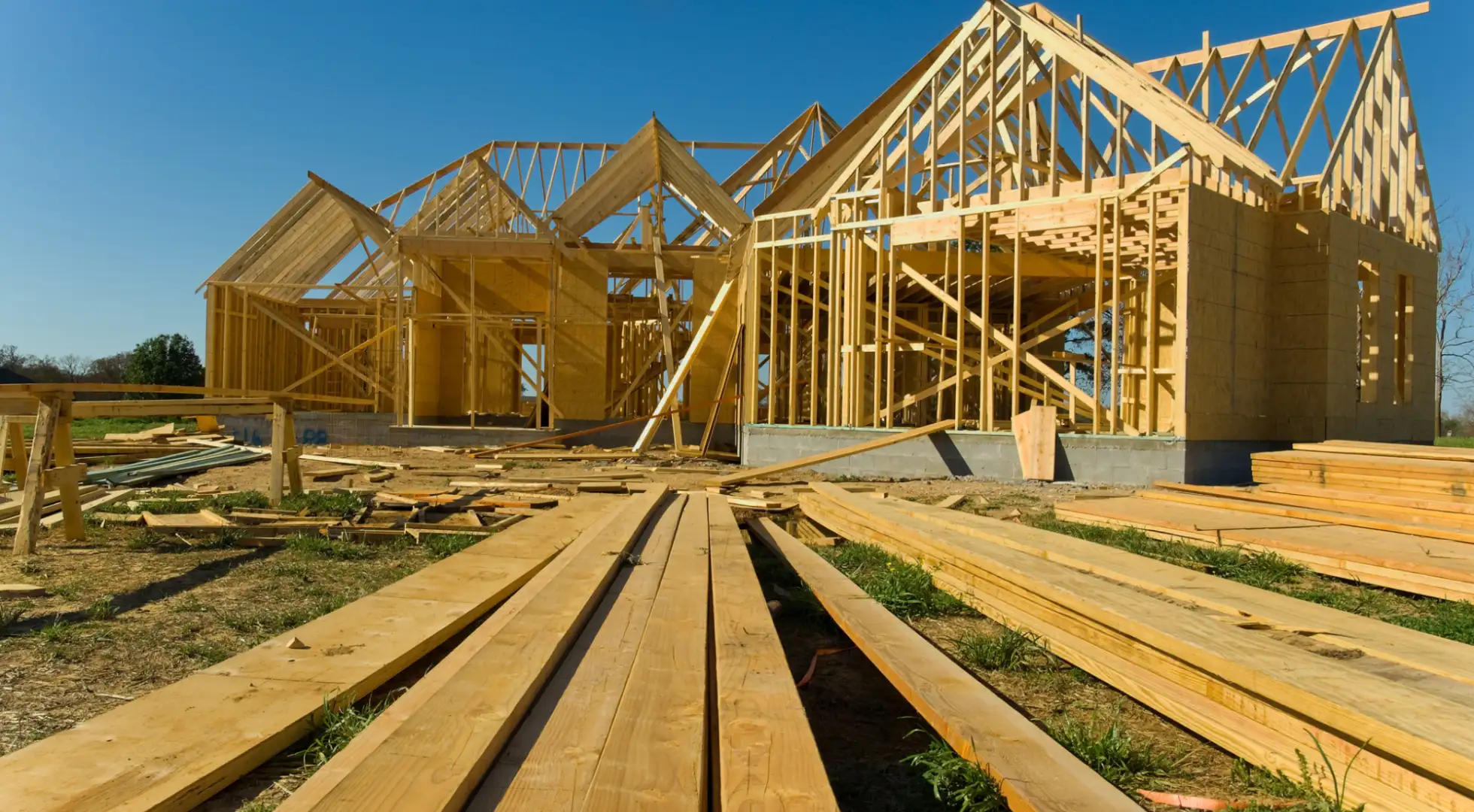
Traditionally, most existing homes and new construction projects in the United States are "stick-built," meaning a timber frame is erected, and facings, insulation, and drywall are added to create the home's envelope. You can see the start of that process in the picture above.
A 3D printer, however, extrudes thin but wide layers, typically of a fast-hardening concrete, one on top of the other. Two walls, one external and the other internal, are built using this process, with an air gap between for better insulation and damp-proofing.
It can be a dream for architects because of the technique's susceptibility to "contour crafting," which allows curved walls and intricate detailing.
While most 3D-printed homes are currently built using concrete, some have experimented with bonded wood-based materials. Owing to concrete production's high carbon emissions, there is also talk of “lavacrete,” a mixture of pulverized red lava rock, cement, and water.
"Additive manufacturing, as 3D printing is also known, involves using computer-generated designs to create three-dimensional objects from a digital file, built up layer by layer," says the World Economic Forum. "Complex shapes can be created easily, and it uses less materials than conventional manufacturing methods. As parts and products can be printed on-site, transportation logistics are also reduced."
Professional construction workers are still need to add a roof, fit windows, and deliver electrical wiring and plumbing.
Are 3D-Printed Homes Any Good?
When, in March 2025, CNBC visited a development of 100 3D-printed homes in Georgetown, Texas, its reporter was impressed. And she met Holly Feekings and her husband, who had moved in about 12 months earlier.
Feekings was especially enthusiastic about her utility bills. Owing to 3D-printed homes' superior insulation, her electricity bill the previous month had been $26.
"I feel safer in this house than any house I’ve ever lived in, because it’s so well built, it’s not going to burn down," Feekings told CNBC. Another resident, Pierre Megie, told the reporter the appeal was "Really just a combination of energy efficiency, the practicality, the price point, and then the aesthetics."
Industry Claims
"3D construction printing offers a revolutionary alternative to traditional construction methods, allowing for greater affordability and efficiency," said COBOD, which builds these 3D printers. "According to a recent article in the World Economic Forum, 3D printed houses can cost up to 45% less than those built with traditional methods, by eliminating the need for expensive materials and labor."
COBOD also says, "3D printed houses offer a distinct advantage over traditional construction methods when it comes to speed. 3D printed houses can be constructed up to 20x faster than traditional construction methods, resulting in significant time and cost savings."
Potential Downsides
At the end of 2023, the National Association of Home Builders said, "With 3D printing in construction still in its infancy, many jurisdictions do not have laws or regulations dictating use. Local building codes also will need to be modified to accommodate 3D printing, and local building and code compliance departments must become conversant in this new building method."
This bureaucratic hurdle may be the biggest barrier to the widespread appearance of 3D-printed homes. But it's not the only one.
Two years ago, Dr. Harold D. Hunt of the Texas Real Estate Research Center at Texas A&M University published a list of questions that raised doubts about the viability of the 3D-printed homes industry. Hunt didn't try to answer those questions definitively, but it may be an antidote to industry hype.
Hunt questioned everything, from cost-saving and speed-of-construction claims, through environmental sustainability and adaptability post-construction, to appraisal and building code and zoning issues. And his questions are good.
But some of them apply to all new technologies. It takes years to achieve economies of scale and to refine techniques to reach speedy outcomes. And it can take even longer to persuade mortgage lenders (maybe that's what Olick was hinting at) and local politicians to embrace a radical innovation.
If 3D-printed homes can eventually be built quickly and inexpensively, they could be an important part of the construction program needed to address the United States' housing supply gap.