
Is Your Home Fully Covered? A Guide to Property Insurance Beyond Basic Homeowners Policies


Carrying the right types of property coverage can help ensure that your home and possessions are protected against the various risks associated with homeownership.
Buying a home is a major investment, and just like any investment, it's crucial to safeguard it against risk. One effective way to mitigate the dangers associated with homeownership is to carry the right types of insurance. Oftentimes, though, this takes more than just a basic homeowner's policy.
We'll walk through the various types of property coverage available and explain how each may be of use to you.
Types of Property Coverage
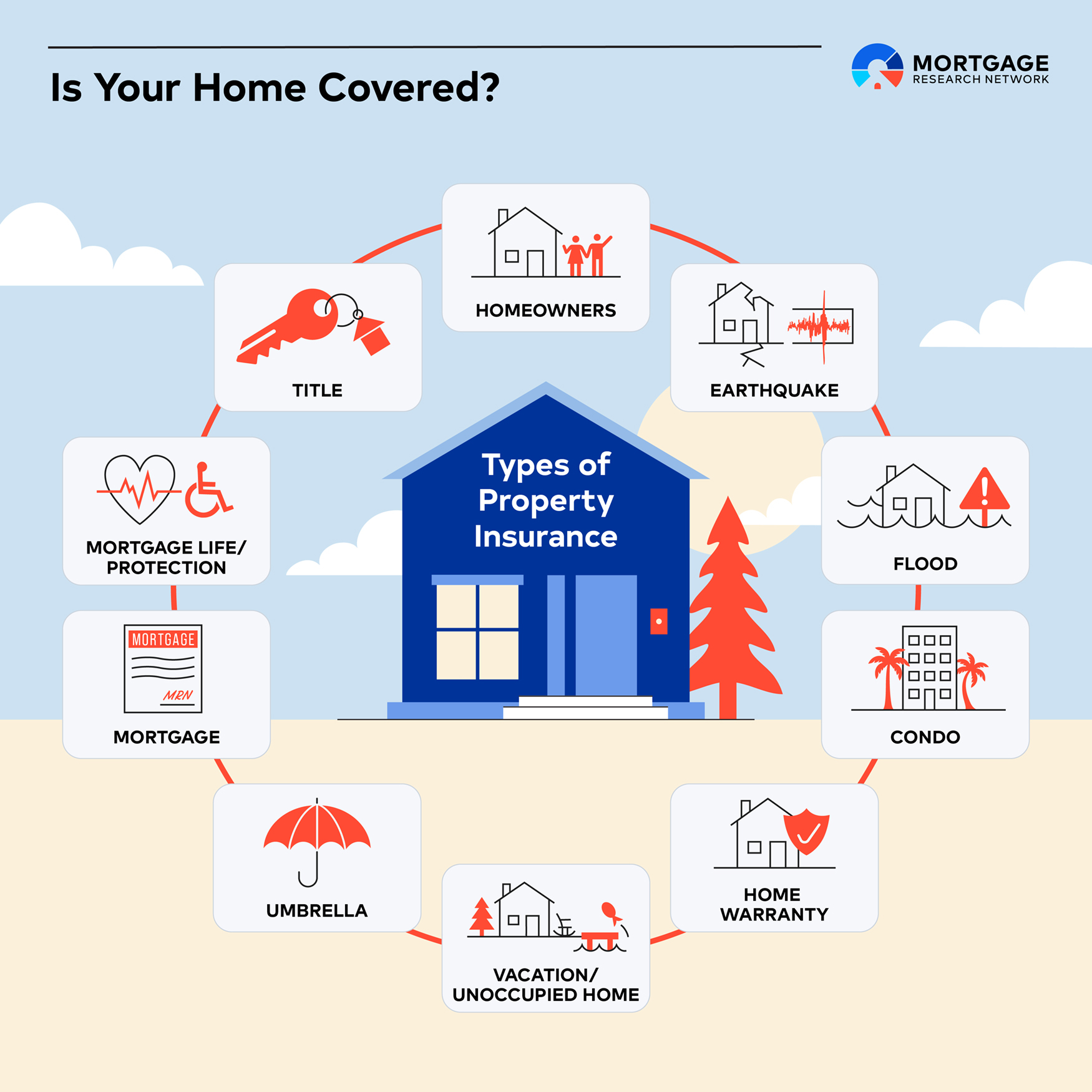
Let's start by taking a quick look at the different types of property coverage before diving a little deeper into each.
| Insurance Type | Use |
|---|---|
| Homeowner’s Insurance | Insures your home and personal belongings against hazards such as fire and theft. Also provides liability protection. |
| Earthquake Insurance | Insures against earthquake damage, which is excluded by standard policies. |
| Flood Insurance | Insures against flood damage, which is excluded by standard policies. |
| Condo Insurance | Similar to homeowner's insurance, but only insures items within your condo or co-op. |
| Mortgage Insurance | Protects your lender from loss in the event you quit making your mortgage payments. |
| Mortgage Life/Protection Insurance | Pays off your mortgage in the event of death. Some policies also include disability or long-term illness. |
| Title Insurance | Protects against unknown liens and claims to your home that weren't discovered during the title search. |
| Umbrella Insurance | Adds additional liability protection, typically $1 million or more, to your existing homeowner’s insurance. |
| Vacant/Unoccupied Home Insurance | Insures homes that are vacant or unoccupied for extended periods. |
| Home Warranty | Warranties the individual components of your home, such as your refrigerator or air conditioner. |
Homeowner’s Insurance
Homeowner's insurance is the most well-known type of property coverage, insuring against damage to your home and the loss of personal belongings. It also protects against liability if a visitor injures themselves and seeks compensation, or if one of the residents in your home damages another person's property.
Most policies include an Additional Living Expense (ALE) benefit in the event your home is damaged and you’re forced to live elsewhere while repairs are being completed. ALE covers the cost of a hotel or alternate living space, increased food expenses, and the moving and storage of your belongings until the work is finished.
Homeowner's policies may pay out either the replacement cost value (RCV) of damage to your property, or the actual cash value (ACV), which takes into account wear-and-tear and depreciation. In many cases, ACV policies may not provide sufficient coverage to fully repair your home or replace your personal property.
More than 86% of homes are insured by a homeowner's policy. If you have a mortgage, your lender will typically require it. In most cases, you will pay for your policy through an escrow account, with the costs included in your monthly mortgage payment.
What Does Homeowner’s Insurance Cover?
Generally speaking, homeowner’s insurance covers damage or loss from:
Fire
Lightning
Windstorms
Explosions
Smoke
Ice and snow
Vandalism or theft
Water damage from sudden and accidental plumbing leaks
Keep in mind, however, that not all policies are the same. Be sure to speak with your insurance provider to understand exactly which scenarios you are protected against.
What Does Homeowner’s Insurance Not Cover?
Standard homeowner's insurance policies do not cover all of the perils that could cause damage or loss to your home.
These excluded events commonly include:
Earthquakes
Flooding
Mold
Pest infestations
Sewage backup
Landslides and mudflows
Sinkholes
Neglected maintenance or intentional damage
Typical wear and tear
Earthquake Insurance
Earthquake insurance is a specialized type of property insurance that provides coverage for damage and loss caused by seismic activity. Since typical homeowner's policies do not cover earthquake damage, earthquake insurance is usually offered as either an add-on endorsement or a standalone policy.
Although most lenders do not require you to carry earthquake insurance – even in high-risk areas – coverage can still provide peace of mind. This is particularly true for structures that are more susceptible to earthquake damage, which can often include cracked foundations and collapsed walls.
Flood Insurance
Similar to earthquake insurance, flood insurance is a unique type of add-on endorsement or standalone policy that provides coverage for your home and belongings in the event of intrusion from rising water or coastal surges.
Flood protection policies can be obtained either through a private insurance provider or the National Flood Insurance Program (NFIP), which is administered by FEMA.
Lenders generally require borrowers to obtain flood insurance for properties that are located within designated Special Flood Hazard Areas. This requirement is mandatory for government-backed loans insured through the FHA, VA, or USDA.
Condo Insurance
Condo insurance is similar to homeowner's insurance, except that while homeowner's insurance covers your entire structure, condo policies only provide protection for the interior of your condo or co-op.
Condo buildings and their common spaces are typically covered by a master policy carried by the condo owner’s association. Because your policy only protects the inside of your unit, condo insurance tends to be cheaper than insurance for a single-family home.
In most cases, the types of scenarios covered or excluded by a condo insurance policy will be the same as those by a standard homeowner's insurance policy.
Mortgage Insurance
Mortgage insurance is an insurance policy that protects your lender against loss if you default on your loan. This means that, while you'll pay for mortgage insurance if required, your mortgage provider is the sole beneficiary.
The two most common types of mortgage insurance are private mortgage insurance (PMI), required on some conventional loans, and the mortgage insurance premium (MIP) assessed on FHA loans.
Conventional lenders require borrowers to carry PMI if their loan balance exceeds 80% of the home's appraised value. Once borrowers reach 20% equity in their property, they can request to cancel their private mortgage insurance. PMI costs vary based on the borrower's credit score, loan term, and their loan-to-value (LTV) ratio.
FHA loans come with mortgage insurance premiums (MIPs), both upfront when the loan is funded and annually thereafter. The upfront mortgage insurance premium (UFMIP) is equal to 1.75% of the amount borrowed. The ongoing annual MIP can range from 0.15% to 0.75% of the mortgage balance. Most FHA buyers will pay an MIP rate of 0.55% for the life of their loan.
Other loan programs will have fees that function similarly to mortgage insurance, such as the VA upfront funding fee and the USDA upfront/annual guarantee fee.

Mortgage Life/Protection Insurance
Mortgage life insurance, also referred to as mortgage protection insurance, pays off the remaining balance of your loan in the event of your death. This helps to keep a remaining spouse or other family members in the home without the burden of maintaining the monthly payments.
Some mortgage life insurance policies also protect against long-term illnesses or disabilities that prevent you from earning income. This could be short-term coverage, with the insurance company making your mortgage payments until you recover, or it could be complete satisfaction of the loan in the event of a lifelong health issue.
Unlike PMI/MIP, mortgage life insurance is designed to benefit the borrower, not the lender.
Title Insurance
Title insurance protects against issues with the title to your home, such as unknown liens, document errors, and claims to ownership. If a problem arises, the title insurance policy will cover any potential losses and the legal costs associated with clearing the title.
During the homebuying process, a title company will conduct a comprehensive title search that includes reviewing public records, compiling a complete chain of ownership, identifying any unpaid liens, and ensuring there are no undisclosed legal restrictions. Title insurance protects against any issues that go undiscovered during this process.
Title insurance can be held as a “lender’s policy” or “owner’s policy.” Most mortgage companies will require you to obtain a lender's policy, but it's typically recommended that you purchase an owner's policy as well.
Some loan types now allow an attorney opinion letter in lieu of a title policy.
Title insurance policies are paid for with a one-time fee, customarily included in your closing costs. The policy will remain in effect as long as you own your home (for owner’s policies) or until your mortgage is paid off (for lender’s policies).
Umbrella Insurance
Umbrella insurance is a type of property coverage that supplements your existing homeowner's policy and provides increased liability protection. While umbrella insurance does not typically cover damage or loss to your home or belongings, it does protect you from liability for injuries to others or damage to other people's property in excess of your standard policy limits.
Umbrella policies typically begin at $1 million in coverage and go up from there. While umbrella insurance can be helpful to everyone, it's most commonly obtained as a safety net by high-income, high-asset homeowners.
Vacant/Unoccupied Home Insurance
Vacant and unoccupied home insurance is designed to cover homes that are left empty for extended periods.
With most standard homeowner's insurance policies, properties that have been vacant or unoccupied for more than 60 days (30, in some cases) are typically excluded from coverage. This is because homes are more susceptible to problems such as fire damage, plumbing issues, or vandalism when no one is there to spot or prevent them.
Some examples of scenarios where you may need vacant or unoccupied home insurance could be for a:
Home you've moved out of, but don’t plan to sell right away
Second/vacation home that you only occupy for part of the year
Rental property with an extended vacancy period between tenants
As with many other types of supplemental insurance, vacant and unoccupied home insurance can be obtained as either a separate policy or an add-on endorsement for your existing homeowner’s insurance.
Home Warranty
While not technically insurance, a home warranty is a type of property coverage that protects you against the failure and normal wear and tear of your home's systems and appliances.
Whereas a homeowner's policy insures you against damage to the structure and your belongings, home warranties are specifically designed to cover the repair and replacement of individual components such as stoves, HVAC systems, and plumbing.
Home warranties are typically issued for a term of one year and can be a practical investment when purchasing a home. Many times, homebuyers opt to negotiate a seller-paid home warranty as part of their purchase agreement.
Is Your Property Covered?
Sometimes, simply having a homeowner’s insurance policy isn’t enough. This could mean adding earthquake or flood coverage to guard against natural disasters, or carrying mortgage life insurance to provide long-term peace of mind for your family. By understanding the different types of coverage available, you can make an informed decision to safeguard your home and financial health.