



If you’ve never purchased or owned a house before, it’s natural to feel a bit overwhelmed. You likely have many first-time home buyer questions that require answers.
5 Questions First-time Homebuyers Should Ask Themselves
First, it’s a smart idea to have a self-dialogue about your objectives, responsibilities, and needs.
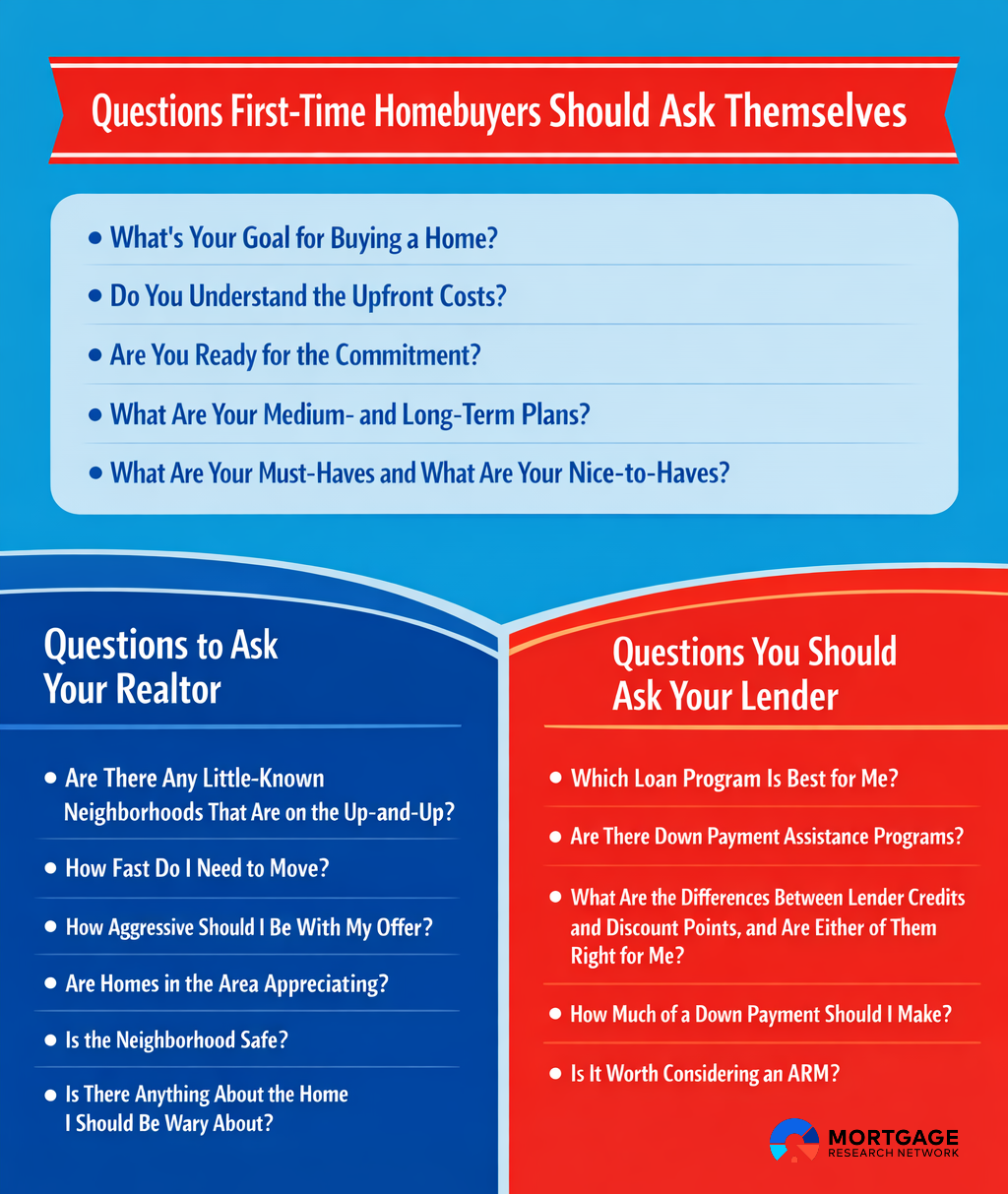
1. What’s Your Goal for Buying a Home?
Understanding your “why” is crucial. Are you purchasing for stability, to start building equity, or as a stepping-stone investment?
“Your goal will influence everything from the neighborhood you choose to the type of mortgage that fits best,” explains Carl Holman, director of marketing for Foundation Mortgage Corporation. “For example, if you know you’ll only be in the home for a few years, you might weigh flexibility over a long-term fixed mortgage rate.”
Dennis Shirshikov, a professor of finance and economics at City University of New York/Queens College, agrees.
“Clarity is forced by this query. The financial ramifications and timelines of a short-term starter home vs. a long-term rental investment vs. a personal residence will vary. Your response to this question should indicate whether your purchase is in line with your wealth-building objectives, lifestyle, or a combination of the two.”
2. Do You Understand the Upfront Costs?
Your upfront expenses can include the down payment, closing costs, and unexpected out-of-pocket liabilities that can add up to thousands of dollars. While some loan programs – VA loans and USDA mortgages in particular – can be had for zero down if you qualify, other financing options require 3% to 20% down. Bear in mind that closing costs can average 2% to 5% of your purchase price, too.
“Surprises can pop up as well, such as higher-than-expected appraisal costs or a requirement to escrow your homeowners insurance,” Holman says. “First-timers should explore down payment assistance programs, ask their lender about seller concessions, and create a savings cushion so they are not stretched thin at closing.”
Nick Rafter, a licensed real estate agent with Bond New York, insists that it’s vital to have more savings salted away well beyond your down payment “in case of a job loss or other life circumstance interferes with your ability to pay your mortgage, taxes, or ongoing homeownership costs.”

3. Are You Ready for the Commitment?
Owning a home involves long-term financial and emotional duties. Paying off your mortgage, making repairs, and covering property taxes constrain your budget if you are not prepared.
“Ask yourself if you are ready to settle in one place and manage ongoing costs. In uncertain economic times, steady income and emergency savings are essential before taking on a long-term mortgage,” recommends personal finance expert Baruch Mann.
Remember that you can’t simply pick up and leave the home when your circumstances change – unlike when you rent a property.
“A home is likely to be the most expensive purchase you will make in your lifetime. If you have a mortgage, you are making a long-term commitment that will likely have you living in the same spot for years,” says Rafter. “Think of it like getting married or raising a child, and treat picking a house with the same seriousness as you would take marriage or parenting.”
4. What Are Your Medium- and Long-Term Plans?
Think carefully about how long you plan to remain in the home, if and when you may want to refinance your loan, and different life changes that can happen over the next 5 to 10 years.
“Most first-time purchasers remain in their first home for 5 to 10 years,” says Todd Christensen, a housing counselor with Money Fit by DRS.
Be aware that moving too early can erase equity gains you make. Think carefully about your breakeven period – the amount of time it takes for the financial benefits of ownership to outweigh the upfront costs of purchasing, including the down payment, closing costs, and moving expenses. It’s the point at which owning becomes cheaper than renting.
“Consider future family plans, commuting needs, and resale potential. Even if today’s rate feels high, refinancing in the future could improve your affordability if rates drop,” says Holman.
Consider future family plans, commuting needs, and resale potential. Even if today’s rate feels high, refinancing in the future could improve your affordability if rates drop.
5. What Are Your Must-Haves and What Are Your Nice-to-Haves?
Prioritize your non-negotiable needs well ahead of time to streamline your search and avoid costly compromises.
“This clarity will help you focus on homes that truly fit your lifestyle and budget,” Christensen notes. “But be careful not to let emotions take over. Trust in a real estate agent for support, who can help you remain on track when it comes to finding a home that matches your needs.”
As this is likely to be a long-term commitment, it’s crucial to consider upfront what you want and can’t live without vs. things you are willing to compromise on.
“The good thing about purchasing is that, in most scenarios, you can usually – if space and circumstances allow – add to your nice-to-haves list later, such as postponing that desired dishwasher or extra half bath,” Rafter says.

5 Questions You Should Ask Your Lender
Next, it’s a good idea to discuss financing issues and related top-of-mind questions with your chosen mortgage lender. Here’s a sample of some of the most common queries borrowers ask.
1. Which Loan Program Is Best for Me?
Loan programs vary widely, and making the right choice can result in lower upfront expenses and expanded eligibility.
“To best determine the loan program that’s right for you, your lender should ask you questions about your income, credit score, money you have available for a down payment, and how long you plan to stay in the home,” says Tanya Bates, senior vice president and regional director of home loans for Bank of Oklahoma Mortgage. “You should expect guidance, not a sales pitch. They should help you understand why one program fits your goals better than another.”
Note that every borrower’s financial profile is different. While a conventional loan could be ideal for many, FHA, VA, USDA, or non-qualifying mortgage programs could be a better fit for others.
“Ask your lender to walk you through every program side-by-side, showing you both short-term affordability and long-term costs for each option,” advises Holman.
2. Are There Down Payment Assistance Programs?
The down payment requirement is often the biggest hurdle to acquiring a home. Fortunately, assistance programs are available that can reduce that burden.
“For example, conventional loans allow qualified borrowers to purchase a home with as little as 3% down, with extra incentives available for those under certain income limits,” Bates adds. “Government-backed options, including FHA loans that require as little as 3.5% down, are designed for buyers with limited savings and lower credit scores. VA and USDA loans offer no down payment for eligible borrowers. And the Native American Home Loan Guarantee Program offers low down payment and flexible credit options for Native American borrowers.”
Additionally, there are hundreds of local and state programs offered nationwide that provide grants, bond programs, or second-lien assistance to help cover down payment and closing costs.
“Many states and cities offer grants, forgivable loans, or low-interest loans to help with down payments and closing expenses, especially for first-time buyers. Ask your lender about eligibility and application deadlines,” says Mann.
3. What Are the Differences Between Lender Credits and Discount Points, and Are Either of Them Right for Me?
Lender credits are dollars that the lender provides (to lower your upfront costs) in exchange for a higher interest rate. Discount points can be purchased to lower your interest rate.
“To determine if either option is beneficial, consider how long you plan to stay in the house and what the cost of paying discount points will be vs. the savings and monthly payment, and how many years you need to stay in the home to break even,” suggests Bates.
4. How Much of a Down Payment Should I Make?
Making as large a down payment as you can afford will reduce your monthly payments and could help you sidestep mortgage insurance. It’s a misconception that borrowers must make a 20% minimum down payment. As mentioned earlier, there are loan programs where little to no down payment is required.
“Often, it’s smarter to put down less and keep an emergency fund, especially for first-time buyers who may face unexpected maintenance and repair expenses as well as other unexpected costs,” Holman says.
Working closely with a local trusted lender can help you determine the right balance between what you put down and what you should set aside for future expenses or emergencies, according to Bates.
5. Is It Worth Considering an ARM?
A fixed-rate mortgage loan is not your only option. Alternatively, you can consider an adjustable-rate mortgage (ARM), which can offer a lower initial rate before the rate become variable.
“An ARM can make sense if you know you will be moving or refinancing within a shorter timeframe. But buyers should understand the risks if rates climb,” cautions Holman.
6 Questions to Ask Your Realtor
Additionally, you’ll want to huddle with your chosen real estate agent/Realtor and get clarity on any further issues you’re not sure about. These are among the most frequently asked questions.
6 Questions to Ask Your Realtor
Additionally, you’ll want to huddle with your chosen real estate agent/Realtor and get clarity on any further issues you’re not sure about. These are among the most frequently asked questions.
1. Are There Any Little-Known Neighborhoods That Are on the Up-and-Up?
Before the market takes notice, savvy agents frequently realize where value is subtly increasing. A knowledgeable professional can point to up-and-coming areas where prices remain relatively affordable.
“With housing affordability shrinking, purchasing early in a growing neighborhood can build equity more quickly. Ask your agent to share data on local trends, planned projects, and long-term community investments, which can help guide your buying decision,” recommends Mann.
2. How Fast Do I Need to Move?
Inquire with your agent about how long homes in your price range tend to stay on the MLS. If supply is low and demand is high, you may need to act quickly. But if the market is slower, being patient can help you negotiate better terms or closing expenses without rushing into a decision.
“Your agent should be able to tell you the estimated timeframe you can expect,” says Rafter. “Purchasing with cash almost always takes less time than when a mortgage is required. In my experience, cash deals can close in as quickly as a month vs. 60 to 75 days or longer with financing deals. For co-ops and new development condos, you could be looking at four to six months or more. Timelines can vary depending on whether there are issues with the property, such as open permits.”
3. How Aggressive Should I Be With My Offer?
You may need to bid higher than the asking price or be willing to waive particular contingencies in competitive markets.
“But in slower markets, a more conservative offer could win. Your agent’s insight is invaluable here,” Holman says.
Ask your agent how much flexibility the seller currently has. Remember that in a high-rate environment, many properties sit, providing more leverage to buyers.
“A good agent knows when to push with a stronger offer and when to wait. The right balance prevents overpaying while keeping you competitive in negotiations,” Mann suggests.
4. Are Homes in the Area Appreciating?
Your agent can offer a comparable property report and recent sales data that indicate if and to what extent homes in your chosen neighborhood are appreciating in value.
“This can give you long-term value context,” says Shirshikov. “Buying in that location could still be a good fit if appreciation is slow, but you’ll need to balance the potential financial gain against the lifestyle advantages.”
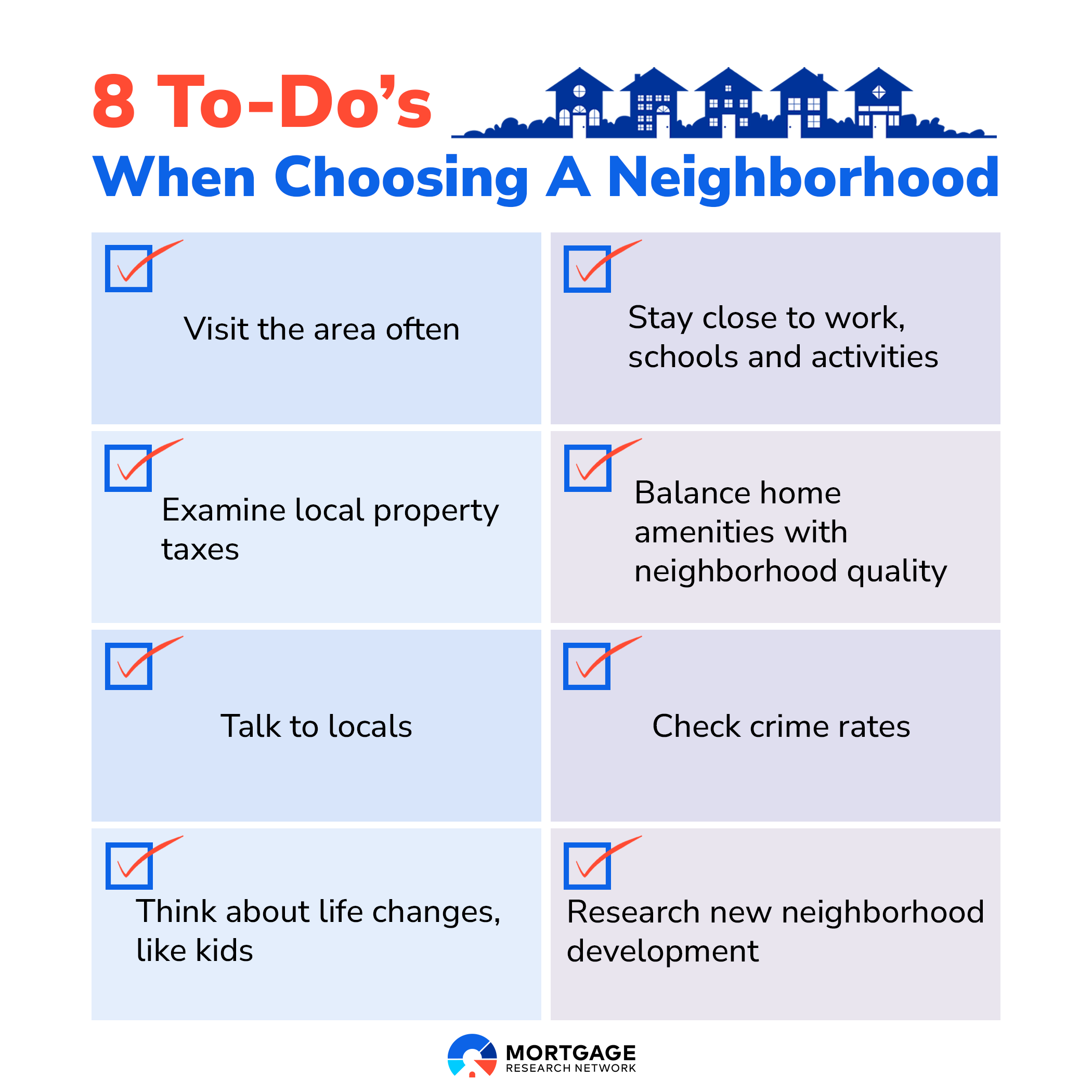
5. Is the Neighborhood Safe?
Area safety and crime rates will impact your quality of life and long-term value. Although agents can’t always disclose crime statistics directly, they can point you to resources and provide context.
“Visit the neighborhood at different times of the day to observe activity,” Mann advises. “In a softer economy with signs of rising unemployment, neighborhoods with strong community ties and good infrastructure often maintain property values more reliably.”
6. Is There Anything About the Home I Should Be Wary About?
The seller’s agent is legally required to disclose any known material defects or issues that could affect the home’s safety, value, or desirability. Your (buyer’s) agent is not responsible for uncovering or disclosing hidden or unknown problems because their primary role is to represent your interests throughout the process. But if your agent becomes aware of a material defect, they are at least ethically expected to let you know so that you can make a more informed decision and opt for recommended inspections or negotiations. Agents who are honest about hidden problems demonstrate that they care more about your long-term happiness than a quick sale.
“Buyers' agents will often ask their connections with title companies or do their own research to learn if there is anything the listing agent might not have told you,” says Rafter.
Ask the Right Questions, Get the Right Home
It pays to think ahead and inquire about anything you’re uncertain about in a real estate transaction. Take the time to list out and pose as many questions as you can think of that can be asked of your agent, your lender, and yourself. This due diligence can prevent you from regretting a costly decision and overcommitting beyond what you can afford or tolerate.
“First-time buyers should remember that the right team makes all the difference,” adds Holman. “A trustworthy lender, knowledgeable agent, and a clear personal plan create confidence through the process. Don’t be afraid to ask every question that comes to mind.”
Mann seconds those sentiments. “In this market,” he says, “it’s smart to stay patient, informed, and financially prepared, which gives you better negotiating power.”