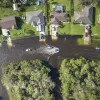



"In 2025, 23 weather and climate disasters struck the U.S., costing $115 billion in damages," says a new report from LexisNexis. "One event, the Los Angeles wildfires, was the costliest wildfire ever recorded in the U.S., with costs estimated at more than $61 billion. As climate change lengthens extreme weather seasons and expands at-risk areas, homeowners and insurers face increasing exposure."
It's way above our pay grade to argue over whether or not climate change is manmade, aka anthropogenic. But the fact that the climate is changing is undeniably revealed in the number of insurance claims related to extreme weather events.
2025 in Context
Of course, few phenomena affecting nature follow straight-line progressions, and last year brought some good news, according to the LexisNexis 2026 U.S. Home Trends full report, which runs to 46 pages:
"Although loss cost across all perils decreased in 2025, it was still the third most expensive year for loss cost for the U.S. home insurance industry within the last seven years," says LexisNexis.
"Loss cost was 50.0% higher [in 2025] than in 2019 and continued its upward seven-year trend," continued the report. "Severity, however, rose significantly for all perils to the highest it’s been over the last seven years. Compared to 2019, it was up 93.2%."
Another report, this time from policy-neutral 501(c)(3) nonprofit Climate Central, continued the dissection of 2025: "Research by Climate Central shows that during 2025, there were 23 individual weather and climate disasters with at least $1 billion in damages.
"This was the third-highest count of billion-dollar disasters (inflation-adjusted to 2025 dollars) since 1980, trailing only 2023 and 2024, with 28 and 27 events, respectively," continued the report. "The total, direct cost of these 23 events in 2025 was approximately $115.0 billion, with 276 direct and indirect fatalities."
Climate Central also says the time between billion-dollar extreme weather events has dropped from 82 days in the 1980s to 16 days in the last 10 years. That was one event roughly every 10 days in 2025.
What Pushes Homeowners' Premiums Higher?
Back in May, the Pew Research Center published the results of a survey it conducted. It found that 71% of respondents said their homeowners insurance premiums had gone up over the previous few years, including 42% who complained they'd gone up a lot. What or whom did they blame?
"The two reasons people cite most often for these price increases are insurance companies wanting to make more money and the costs of repairing and rebuilding," says Pew. "A sizable share of homeowners also point to extreme weather events as a reason."
Insurers' Profitability
Of course, insurers would argue that they've been between a rock and a hard place for several years, with higher and more frequent homeowner claims squeezing their profitability.
However, critics disagree. "Insurance companies continue to hike rates for consumers despite massive profits, raising serious questions," said Mekedas Belayneh, researcher with Public Citizen's Climate Program, quoted by InsuranceNewsNet.com. "The industry's repeated claims of financial distress, used to justify higher rates and weaken consumer protections, are impossible to square with its record profits in recent years.
"Insurers are profiting from both the causes and consequences of climate change while consumers are left paying higher premiums, receiving less coverage, and facing shrinking claims payouts," Belayneh continued. "This is a system that works for the insurance industry's bottom line only."
Repair and Rebuilding Costs
Whether consumer advocates or insurance industry bosses are right about profitability, homeowners make sound points when they cite the costs of repairing and rebuilding damaged homes. Still, even those costs rose less quickly last year than in 2024.
"[Across California], repair expenses rose 3% in the past year – down from a 4% gain during 2025, and 7% annual hikes in the previous five years," said Mercury News on Jul. 10. "Still, they’re up 50% from 2019."
While that report covers only one state, we can't think why it wouldn't apply to a greater or lesser extent elsewhere. However, there's now a new fly in the ointment
On Monday, the U.S. announced new 50% tariffs on Canadian imports. The New York Times's list includes plywood, particle board, and softwood lumber, while the White House adds cement.
Of course, all these are materials used in construction and are likely to become more expensive if the tariffs are fully implemented. Meanwhile, construction labor costs are rising more quickly than other salaries.
"According to Associated Builders and Contractors (ABC), the U.S. construction industry will need approximately 349,000 net new workers in 2026 and 456,000 additional workers in 2027 — on top of normal hiring — just to keep supply and demand in balance," said ABC in February.
Skilled workers, already in short supply, are increasingly drawn to data center construction, while some immigrants working in the industry face visa concerns.
What's Next?
What happens to homeowners insurance premium renewals over the rest of this year and into 2027 will depend on the incidence and severity of extreme weather events, insurers' profit margins, and the costs of repairs and rebuilding.
Last year was exceptional in that the cost of losses due to wind peril plummeted by 50.4% from 2024, according to LexisNexis. Hail loss costs were down 38.4%, and weather-related water loss costs decreased 40.8%.
However, fire and lightning costs soared by 76.8%, largely driven by last January's wildfires in and around Los Angeles. But what about 2026?
There's already some good news. The National Oceanic and Atmospheric Administration has announced, "NOAA predicts below-normal 2026 Atlantic hurricane season." So, Floridians and others who are often affected may have grounds for hope.
Indeed, we can all hope that the weather will continue to be kinder this year. However, many records around the world for June temperatures were broken last month. So, we've a long way to go before chalking up 2026 as a good year for homeowners insurance claims.
And, of course, with inflation looking set to rise again in July, repairing and rebuilding homes will likely get more costly. As for insurers' profit margins, those are between them and their customers.