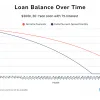


The New York Times ran a report last week under the headline, "The Pros and Cons of Paying Off Your Mortgage Early." It suggested that someone with a new $222,000, 30-year fixed-rate mortgage at a 6.67% rate could pay about $68,000 less in interest and finish paying off the loan nearly six years earlier. And all they have to do is make one additional payment each year.
It sounds like a no-brainer. But The Times warns that only some borrowers should immediately take that step. Others should wait until their financial situation improves.
How to Switch to Extra Payment Mode
Those in strong financial positions don't need to delay putting a 13th payment in place. This typically involves arranging with the mortgage servicer (the company that collects payments) to make half of your normal monthly mortgage payment every two weeks. The math is simple: making a half-payment every two weeks adds up to 26 half-payments, or 13 full payments, each year.
It's important, however, to coordinate this with your mortgage servicer before beginning to make biweekly payments. Some servicers may treat an individual half-payment as a partial payment and either return it or hold it until enough funds have paid to cover the month's full owed payment.
While the 13-payment model is a relatively painless way to pay down a loan, some might prefer less structured approaches. For example, those who receive handsome annual bonuses might prefer to take their additional mortgage payment from those funds through a manual transfer. Of course, a borrower might wish to make biweekly payments and extra principal payments when they have surplus cash on hand. Again, be sure the servicer knows to apply all additional payments wholly to the principal.
"Often, monthly loan statements have a line for making additional payments toward principal," said The Times. "It’s generally smart to contact your lender or mortgage servicer before making extra payments. Details may depend on the type of loan, and you want to be sure your extra payment is correctly applied to your principal."
The more that is paid toward your principal balance, the shorter the loan will be, and the less interest will be due. One doesn't owe interest on money that's already been repaid.
Why Wait to Prepay?
- Is sure they can comfortably afford biweekly payments — Don't get into an ongoing commitment that might prove unsustainable.
- Has a substantial emergency fund in place — Ideally, this should keep the family afloat for three months (some say six months). None of us knows when we'll next be hit with a major unavoidable expense or endure a bout of sickness or unemployment. And having a financial cushion to survive one of those is more important than paying down one's mortgage early.
- Wipes out high-cost debts — It makes no sense to reduce mortgage debt at 7% or considerably less when one's paying 21% interest on credit card balances. So, pay down high-interest borrowing before turning to the mortgage. And that might include private student loans.
- Does the math — Some lucky homeowners have mortgage rates in the 2.8%-3.5% range. And it's easy to find federally insured high-yield savings accounts with higher yields than that. So, consider putting the extra cash into one of those. One can always pay down the mortgage later using the (slightly larger) accumulated funds.
- Checks one's mortgage agreement — They're rare now, but occasionally one comes across a mortgage contract that includes prepayment penalties, which are effectively fines for paying off all or a large portion of your loan ahead of time. They're often modest, but it's worth knowing whether they exist and how much they may cost before reducing the mortgage balance.
- Considers one's stage in life — Few younger homeowners stay in their homes for 30 years, meaning they might not receive the full benefits of prepayment. They won't finish paying their mortgage in year 24 if they sell and move in year 10, though they should have a lower balance when they sell. However, those approaching retirement may find prepayment a good way to manage their future living expenses.
The Times makes another point: "If you put all your extra cash into your mortgage, you are essentially tying it up in an account that’s difficult to tap," Dr. Stephen Roll, research director at the Center for Social Development at Washington University in St. Louis, told the newspaper. "If you have a sudden financial mishap — a large medical bill or a job loss — you can’t easily get that money."
Who's Paying Extra?
As is often the case with financial matters, this doesn't seem fair. The higher one's rate, the more one stands to save by making 13 payments annually or otherwise paying down one’s loan balance. After all, one is saving on future interest costs, and the higher one's rate, the higher those costs will be.
Still, it's easy to see why those with ultra-low locked-in rates are more likely to prepay: They can afford it more easily because their monthly homeownership costs are significantly lower than those on higher rates.
"Almost 1 in every 4 homeowners is paying off their mortgage at a rate faster than they’re required to — but the people who would benefit the most from this strategy are the ones least likely doing it," wrote The Washington Post last week.
"Interest rates today are much higher than five years ago — not just for home loans, but for bank accounts and investments, too," said The Post. "A person who could hope for a 5 percent return on money they invest in the stock market, but chooses to put that money toward paying off their 3 percent mortgage instead, is losing out on 2 percent of the value."
That's true, but The Post goes on to acknowledge that many want to enjoy the cash flow benefits of being free of their mortgages early. And they can be certain they'll get those benefits, while stock markets can be less reliable, especially at a time when there's talk of a bubble.
"Markets on both sides of the Atlantic reflect investors’ enthusiasm about artificial intelligence (AI) shaping the economy and driving profits," wrote the European Central Bank (ECB — the eurozone's equivalent of our Federal Reserve) last month. "The extremely optimistic valuations raise questions: do today’s stock market prices reflect a rational bet on the transformative technology? Or are we seeing a remake of the dot-com bubble?"
"We argue that economic research on past technological revolutions points to a worrisome conclusion: a correction of current stock market valuations is likely," continued the ECB.
Ultimately, there isn't a universally right answer. Paying down a mortgage early can produce substantial guaranteed savings, particularly for borrowers locked into today's higher rates. But those savings come at the cost of tying up money that could otherwise remain available for emergencies, debt repayment or investing.
For homeowners with strong finances and few better uses for the cash, an extra payment each year can be a practical way to shorten the life of a mortgage. For everyone else, getting the rest of the household finances in order first may be the smarter move.