


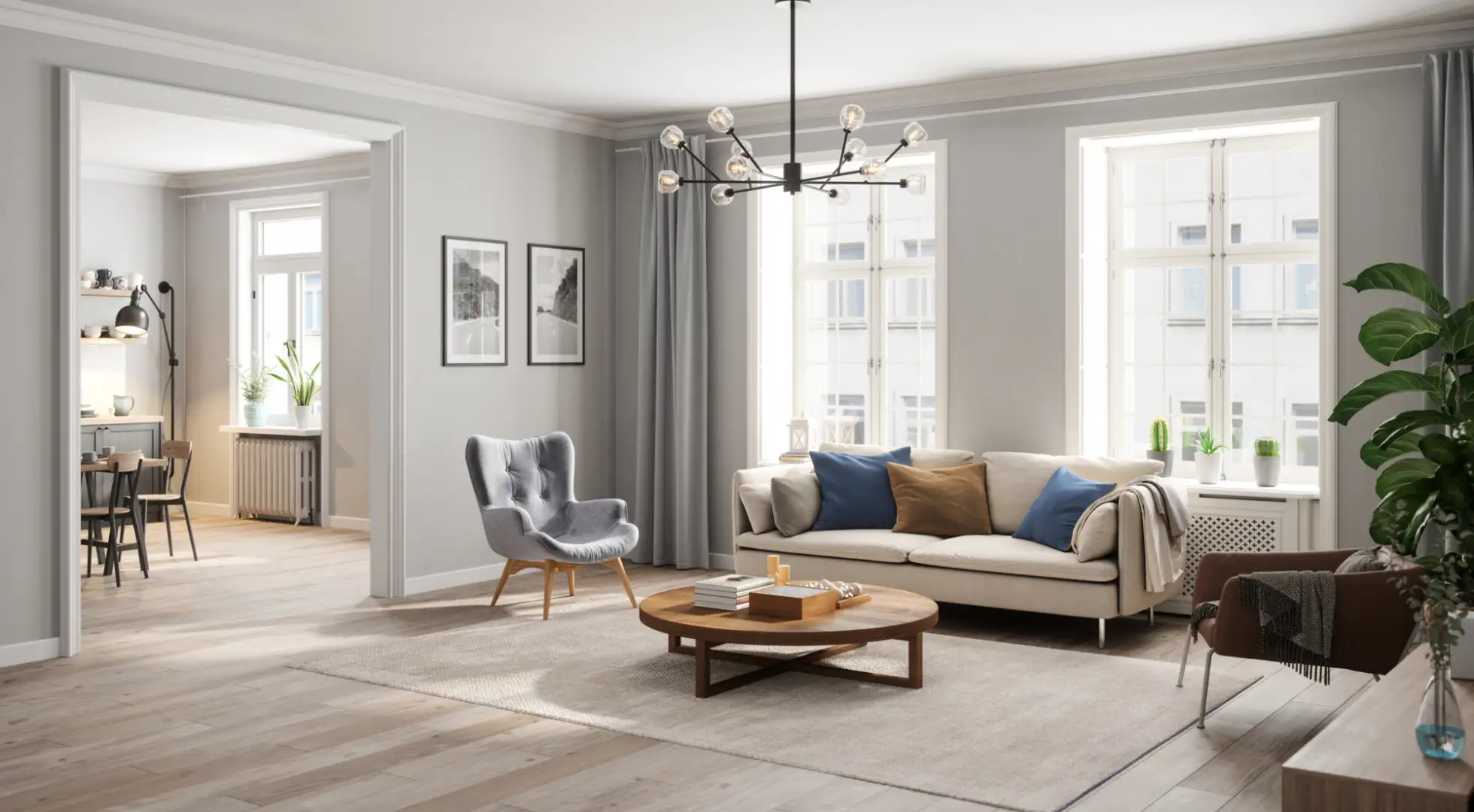
"Zillow® research finds that today's buyers are drawn to warm, grounded interiors over all-white walls," said a company news release earlier this week. "In the living room, pale blue commands $1,723 more than white, and charcoal gray $1,509 more. In the bedroom, it's not just chocolate brown that beats white [by $2,277]. Charcoal gray also commands higher offers, by $1,240, and sage green tops white by $1,035."
Of course, interior design colors come in and out of fashion. But sometimes the speed with which they do so can be dizzying.
The $18,000 Ochre Penalty and Other Costly Choices
Zillow singled out the ochre shade of yellow as a paint color that could slash a sales price by $18,164. Gosh, that must be a deeply unfashionable choice.
Except as recently as last November, Homes & Gardens magazine ran the headline, "Move Over Butter Yellow: Ochre Is the Cozy Neutral Designers Are Loving This Fall." The article underneath said: "Offering the same versatility and uplifting feel as butter yellow but with a lot more depth, ochre is the perfect way to decorate with yellow for the fall and winter months, whether you use it as a neutral or in livelier color schemes."
To be fair, Zillow's $18,164 figure applies only to homes painted ochre in the living room, kitchen, bedroom and bathroom. If a homeowner uses it solely in the kitchen, he or she might be down by a much more modest $6,630.
"Buyers may also offer nearly $8,000 less for homes with a bathroom painted fire-hydrant red," says Zillow. "Pale pink ranks in the bottom three for every room, too, potentially costing sellers $6,013 in the bathroom and $4,201 in the kitchen."
How Serious Is This?
The research from which these figures were derived was conducted by Zillow's behavioral science team. (Who knew? And did they poach members from among Quantico's more sensitive souls?)
No doubt the team takes its results very seriously. But in many parts of the country, the figures proposed are roughly the cost of a new paint job — at least for those who have their interior decorator on speed dial. Are buyers simply saying they prefer a different color scheme and would like the sellers to pay for it, please?
That's not to say that eccentric decoration can't put off home buyers. It's fine for homeowners to paint their interiors in wild colors that reflect their personalities while they're living there.
But as soon as they transform into home sellers, they need a whole different attitude. Their goal should be to appeal to the widest and deepest possible pool of buyers. And it may be time to drop in on Home Depot's paint department for something more neutral — or boring, as they might think.
Other Ways to Sell a Home Sooner and for More
Most homeowners probably already have inoffensive interiors. But there's a common checklist of steps they can take to maximize the proceeds from their sale and minimize the number of days their homes are on the market.
Don't spend a fortune at this point. Additions and major remodelings rarely give a full return on investment.
Just look at the home through a buyer's eyes and address the things many will find off-putting. Here are some tasks to consider:
- Replace cracked sidings and window panes, and fix obvious defects, such as slipped or missing roof shingles. If it looks as if the seller doesn't care for the home, why should the buyer?
- Tidy both the back and front yards. But focus on prettifying the front. Add curb appeal with colorful plantings in beds, pots, and hanging baskets.
- Do a deep clean, sprucing up the interior and exterior. And make windows sparkle. Watch out for smells, especially if you have pets, whom you should hide during viewings.
- Declutter and depersonalize the interior. Put most ornaments, family photos and half your clothes and shoes into storage. Your shelves will look better, the photos that remain will stand out more, and your closets will look bigger. Also, store outsized pieces of furniture that can make rooms appear cramped, along with any artworks or decor that some might find offensive.
- Take a cold, hard look at the kitchen. Most buyers focus on that room. Do you need to replace the faucet, paint the cabinet doors, replace the worktops, or fix broken doors and sticking drawers? If the worktops are crowded with small kitchen appliances, put some of those into storage.
- Carry out other inexpensive upgrades. "Don’t go overboard, or you may end up losing money," advises Timberland Bank. "A paint job and some new light fixtures, door handles and rugs can do the trick."
- If there's a room used just for storing stuff, put the contents into storage. Then furnish it as a bedroom, home office, or something else useful.
- If there's a requirement for new furniture in the next home, consider buying it early and getting the benefit in the current home. This is an upgrade sellers get to keep. But first, read Reasons Home Closings Get Delayed (and How to Avoid Them).
- Don't backslide after the deep clean and improvements. Keep the place within 30 minutes of viewing-ready at all times.
It's a long list, but be brave — not (ochre) yellow — when tackling it. You could gain thousands of dollars, maybe even tens of thousands.