


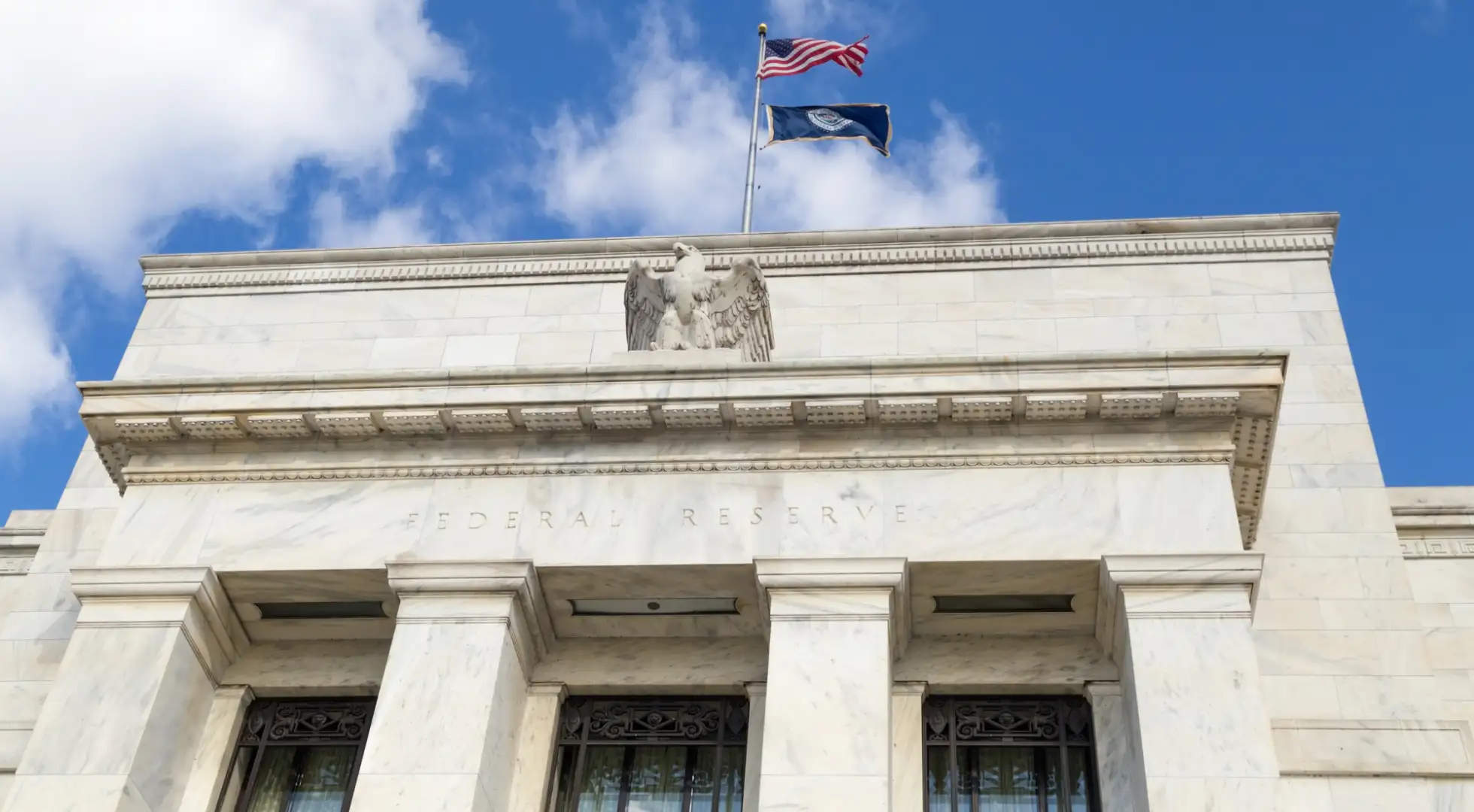
The Fed could help lower mortgage rates in 2026 depending on the new Fed Chair and incoming economic data.
As the nation’s central bank, the Federal Reserve plays an important role in the American economy and its overall financial system, being responsible for managing interest rates and monetary supply. But the Fed has faced plenty of headwinds in recent years in its struggle to control inflation and keep the economy stable.
2025 was a particularly bumpy year for this group. One big reason was due to increasing internal dissent about whether, when, and how much interest rates should be lowered. Earlier this month, the Federal Open Market Committee (the Fed’s primary monetary-policy-making body) decreased its key interest rate by 25 basis points to a range of 3.50% to 3.75%, representing the third consecutive rate cut this year and the sixth since late 2024. President Trump was another reason: He has consistently criticized Fed Chair Jerome Powell and is eager to replace him, when his term ends in May 2026, with someone who prefers much lower rates. As we head toward that transition, it’s fair to question whether his successor will support the Fed’s traditional independence as a government agency or favor the Trump Administration’s more aggressive push for easing rates.
How will things shake out at the Federal Reserve next year? Who will ultimately replace Powell? And can we anticipate more rate cuts in the coming months? For answers, we reached out to a handful of industry insiders and real estate professionals for their predictions and insights.
Q: How Would You Assess the Current State of the Federal Reserve?
Selma Hepp, senior vice president and chief economist for Cotality
The Fed in 2026: Inflation tamed but stuck in the final mile, with cautious rate cuts ahead.
“Heading into 2026, the Fed is in a state of cautious transition. We’re seeing a central bank that has successfully pulled the economy back from the brink of runaway inflation, but it’s now grappling with a sticky final mile. The current range of 3.50% to 3.75% shows they’ve pivoted to easing, but the internal dot plot suggests they are hesitant to go much further. The mood is one of watchful waiting – balancing a softening labor market against the inflationary wildcards of new tariffs and fiscal stimulus.”
We’re seeing a central bank that has successfully pulled the economy back from the brink of runaway inflation, but it’s now grappling with a sticky final mile.
Rick Sharga, president/CEO of CJ Patrick Company
The Fed's impossible balancing act: Cut rates to save jobs or hold steady to fight inflation?
“The Federal Reserve has been in an almost impossible position over the past few years, given its dual mandate of maintaining full employment while keeping inflation under control during a period of time when inflation hasn't been moving steadily towards the Fed's 2% target rate and the job market has weakened significantly. Lowering the Fed Funds rate is typically the response to a weak job market, but doing so also raises the risk of reigniting inflation. In recent months, the Fed has leaned more towards helping the job market by cutting rates and hoping that inflation holds steady, or at least doesn't increase too much. As an indication of just how difficult a balancing act this is for the Fed, its last rate cut vote was one of the most divisive in recent history, with two members voting against a cut, and another voting for a cut twice as big as the quarter-point that was ultimately passed.”
Dennis Shirshikov, professor of finance and economics at City University of New York/Queens College
Fed credibility holds, but the margin for error shrinks as markets react more sharply to every signal.
“The Federal Reserve is heading into 2026 with its credibility intact, but with less room for error than it had earlier in the cycle. The core job is still the same: Keep inflation contained without breaking the labor market. But the market’s tolerance for mixed messaging is lower now, because small shifts in guidance quickly ripple into mortgage rates and consumer credit.”
The Federal Reserve is heading into 2026 with its credibility intact, but with less room for error than it had earlier in the cycle.
Albert Lord, founder/CEO of Lexerd Capital Management
Progress on inflation meets new headwinds: Data gaps, tariff uncertainty, and political pressure threaten Fed independence.
“The macroeconomic backdrop shows progress. Inflation has cooled materially but remains above the 2% target. The labor market is softening, with unemployment at 4.4% to 4.6%. Key challenges include data quality from the 2025 government shutdown affecting economic statistics, tariff policy uncertainty, and the Fed chair transition in May 2026. The Fed faces elevated governance risk and risk around independence given ongoing public pressure around rate policy.”
Robert Johnson, professor of finance in the Heider College of Business, Creighton University
Using the Fed for political gain could result in economic harm.
“The importance of an independent Federal Reserve cannot be overstated. An independent Fed enhances the Fed’s credibility and fosters market confidence in its decisions. For the U.S. central bank to operate effectively, it must be shielded from undue political influence. If the Fed succumbed to pressure from the White House to lower interest rates, it could offer the party in power short-term political gains but result in long-term economic harm.”
Q: What’s Your Assessment of the Job That Powell Has Done as Chair?
Ralph DiBugnara, president of Home Qualified
Powell's steady hand helped, but the middle-class affordability crisis demands more aggressive rate cuts.
“Powell has been a calm and steady voice during a time of turmoil, but I do believe his conservative nature is impeding the changes we need to help the people of this country. The rich have gotten richer, with record highs in the stock market, crypto market, and real estate home prices. But the middle class is being squeezed on all fronts. Higher energy and utility costs, higher insurance and taxes, and a record amount of consumer debt, combined with higher interest rates, have been a recipe to make many cash poor and unable to afford the cost of living today. Powell needs to be more aggressive in bringing down interest rates, or I don't see a light at the end of the tunnel for affordability.”
Rick Sharga
Powell navigated unprecedented crisis with mixed results. Pandemic over-stimulus was corrected, but political upheaval and new tariffs complicate the path forward.
“Powell had the misfortune of being in place when a global pandemic hit, without a particularly useful precedent in place to help guide monetary policy. Both the Fed and the Biden Administration erred on the side of over-stimulating the economy and drastically increasing the monetary supply, with 9% inflation being the unfortunate, but predictable, outcome. The Fed almost certainly kept its zero-interest rate program in place longer than it needed to. The challenges faced since then by the Fed and Powell have been first to get inflation back under control and then to unwind the rate cuts before they harmed the economy. One could argue that the Fed was more successful on the first challenge than the second. Complicating matters is that we had a turnover in the White House and Congress while the Fed was in the middle of executing these corrections. And fiscal policy changes – for example, instituting tariffs, which can often be inflationary, and eliminating tens of thousands of government jobs, which can increase unemployment – have made the Fed's balancing act that much more precarious.”

Fiscal policy changes – for example, instituting tariffs, which can often be inflationary, and eliminating tens of thousands of government jobs, which can increase unemployment – have made the Fed's balancing act that much more precarious.”
Selma Hepp
Powell's measured approach avoids disaster but may have been too cautious.
“Powell’s tenure will be remembered for its better-late-than-never agility. While critics argue he was too slow to start cutting in 2024, his measured approach likely prevented a total inflationary rebound. In hindsight, he may have been too restrictive; however, economic indicators were full of mixed signals. The state of the labor market continues to be hard to evaluate amid a lack of data and inconsistent trends. One would have expected to see a deeper impact on the labor market given uncertainty fears, DOGE actions and their ripple effects, and historically low consumer sentiment. However, the need for deeper cuts seemed to have been offset by outperforming equity markets, AI investments, and continued consumer spending, and accumulation of wealth.”
Dennis Shirshikov
Powell's inflation-first strategy pays long-term dividends—but premature cuts risk undoing hard-won credibility.
“Powell’s tenure has been defined by a willingness to prioritize inflation credibility even when that choice is unpopular, and that has real long-term value because inflation psychology is hard to repair once it breaks. More frequent and deeper cuts only make sense if inflation is clearly and sustainably back in a comfort zone. Otherwise, the Fed risks reaccelerating prices and forcing a more painful second round of tightening later.”
Robert Johnson
Powell navigated unprecedented challenges in a thankless job that gets blamed more than praised.
“The Powell Fed has performed very admirably in navigating a very tough economic and political environment that included an unprecedented pandemic. In my opinion, the Fed chair is a thankless job. Rarely does the Federal Reserve get credit when things go well, but they are often criticized when things go poorly.”
Q: Who Do You Predict Will Replace Powell, and What Will the Effect Be On the Federal Reserve?
Albert Lord: Kevin Hassett, National Economic Council (NEC) Director
“The likeliest candidates are Kevin Hassett, NEC director; Kevin Warsh, the former Fed governor; Christopher Waller, the current governor; and Michele Bowman, vice chair of supervision. Hassett is the most dovish, advocating for significantly lower rates. However, because he is so close to the President, markets may price a politicization premium if investors believe the Fed's actions could tilt toward political preferences, potentially pushing up long rates. Warsh favors Fed reforms and balance sheet discipline; he believes AI will be a disinflationary force. However, his advocacy for simultaneous rate cuts and balance sheet shrinkage may be difficult to execute, and a confrontational regime-change approach can add transition volatility. Waller is the most vocal internal advocate for rate cuts. He is data-driven and fully supports continued cuts if warranted. With deep institutional knowledge, he enjoys strong Wall Street backing. But his personal relationship with Trump is not strong, and he may not deliver cuts at the desired speed, creating political friction. And Bowman is an advocate for small, gradual rate adjustments and is more hawkish on inflation; she is focused more on bank deregulation as a vehicle for growth in the economy. Her preference for restrictive policies, however, makes her less aligned with the aggressive rate-cut agenda. Ultimately, Hassett remains the most likely nominee because he has the closest personal relationship with Trump, Treasury Secretary Bessent appears to favor him, and he most strongly aligns with the President's preference for significantly lower interest rates.”

Ultimately, Hassett remains the most likely nominee.
Dennis Shirshikov: A current senior Fed official such as Waller or Philip Jefferson
“If the administration wants continuity and predictability, a current senior Fed official such as Waller or Philip Jefferson fits that steady hand profile, which markets often like because it reduces the risk of surprises. If the preference is a more explicit pivot toward growth or a different communications style, names like Warsh are often floated because he is seen as more willing to challenge the existing consensus, though the tradeoff is that markets may price more volatility until the new chair’s reaction function is clear.”
Selma Hepp: Kevin Warsh, former Fed governor
“Warsh may be the top pick since he bridges the gap perfectly. He has the street cred of a former governor to calm the markets, but he’s also signaled a willingness to give the White House a seat at the table for discussions. I also put high probability on Waller, an institutionalist who is data-driven but open to easing. He’s a known quantity to markets, but might not represent the radical change the administration wants. Meanwhile, I expect the Fed to move toward more transparency in 2026 with strings attached. The administration is pushing for more consultation between the White House and the Fed. We might see a Fed that is less of an ivory tower and more of a partner in national economic strategy. Whether that’s good for long-term independence is debatable, but in 2026, the focus will be 100% on lowering the cost of debt to service the national deficit and fuel domestic growth, and address the affordability challenges. The administration is very concerned about the lack of housing affordability and will work hard on changing the perception around that.”
Robert Johnson: It’s anyone’s guess
“President Trump prides himself on his unpredictability. I certainly can't predict his choice with any accuracy.”
Q: What Kind of Fed Rate Cuts Can We Expect in 2026?
Nadia Evangelou, NAR senior economist and director of real estate research: 2 quarter-point cuts
“If the economy keeps moving in the direction we are seeing now, I expect about two rate cuts in 2026, most likely later in the year rather than right away. Think two quarter-point cuts. This looks like a gradual easing, not a major cutting cycle.”

I expect about two rate cuts in 2026, most likely later in the year.
Selma Hepp: 2-3 quarter-point cuts
“I expect two to three cuts – 50 to 75 basis points total – with the first in March or April to set the stage for the leadership change and another in late quarter three as the 2026 midterms approach, in 25-basis point increments. The Fed wants to avoid looking panicked, even if the new leadership is more dovish. Also, there is a general understanding that there is a need for a perception of independence, irrespective of the White House influence. Consumers are likely to respond to the rate cuts positively even though experts don’t expect a significant drop in mortgage rates.”
Albert Lord: 3 quarter-point cuts
“I anticipate three cuts totaling 75 basis points, depending on economic conditions and new leadership. The year-end target range should be 2.75% to 3.00%. The markets should not expect rates near 1% as some desire, which would require a severe recession.”
Robert Johnson: 54% chance of 0.75% in cuts
“Currently, according to the Chicago Mercantile Exchange’s FedWatch Tool, there is a 27% probability that by the end of 2026, the Fed will have cut rates by at least 100 basis points. And there is a 54% probability that the Fed will cut rates by at least 75 basis points. This Fed has been very data dependent and has exercised great caution over the last few years – both in raising and in cutting rates. I believe that philosophy could change when the new Fed chair – one who is more closely aligned with President Trump – is in place.”
Dennis Shirshikov: 1-3 quarter-point cuts in mid-to-late 2026
“2026 is more likely to be a calibration year than a dramatic easing cycle, assuming inflation keeps cooling and growth slows without breaking. I would expect one to three quarter-point cuts, likely spaced out and more probable in the middle to later part of the year rather than immediately in early 2026. If inflation reaccelerates or financial conditions loosen too quickly, the Fed may deliver fewer cuts than markets hope, and the bigger story becomes patience rather than pivoting.”
Rick Sharga: 1% in rate cuts by the end of 2026
“The current plans call for a single rate cut of a quarter point in 2026, but it's a safe bet that there will be more cuts, and perhaps deeper cuts, once Powell's successor is in place. Assuming that inflation and the economy are roughly the same then as they are now, we could see two rate cuts in the second half of the year, reducing the Fed Funds rate by a total of one point.”
Ralph DiBugnara: No large cuts on the horizon
“Unless something drastically changes, I don't see any large rate cuts on the horizon in 2026. In the last meeting for December, we saw a minimal rate cut that was not even a unanimous vote amongst the voters within the Fed. This shows you that they are not aligned, and unless a new chair comes in and forces an aggressive cut agenda, we will probably see interest rates only slightly down in 2026.”
Q: How Might The Fed Affect Mortgage Rates and the Real Estate Market in 2026?
Robert Johnson: Markets, not the Fed, will continue to affect mortgage rates
“Consumers and pundits often make the mistake that the Fed sets interest rates. The Fed sets the very short, overnight target Fed funds rate. Many people assume that when that is lowered, mortgage rates will follow. But mortgage rates are tied much more closely to the 10-year Treasury rate and bond market expectations than to the short-term end of the yield curve that the Fed influences.”
Nadia Evangelou: Mortgage rates to average around 6%
“I expect mortgage rates to move lower and average around 6% next year. That may not sound like a big change from the 7% that we had last year, but for housing it's a meaningful shift. A move from 7% to 6% brings about 5.5 million additional households back into the market, including about 1.6 million renters who would once again qualify to buy a median-priced home.”
Rick Sharga: More certainty, lower rates
“The market, and most consumers, hate uncertainty. Having a Fed chair in place whose inclinations and policies are aligned with those of the White House will at least remove one area of conflict and allow businesses and households to plan with some degree of certainty. All signs point toward policies geared to lower interest rates, which eventually should result in lower-priced mortgages as well, which would improve affordability for homebuyers and possibly accelerate home sales from the lackluster numbers we've seen for the past three years.”
Dennis Shirshikov: Mortgage rates could fall if the Fed remains independent
“The main short-term change new leadership brings is communication risk, because markets price narratives as much as they do data. Should the next chair be seen as predictable and data-dependent, mortgage rates have the capacity to settle and drift lower as confidence in inflation rebounds; that can do much to thaw transaction volume even if prices don’t quickly skyrocket. If it is seen as a politically pressured or inconsistent new chair, mortgage rates can remain elevated simply because the risk premium increases, and that may leave housing activity weak even if the Fed itself is technically easing.”
Albert Lord: Dovish Fed chair could lead to mortgage rates in the 5.5% to 6.25% range
“Long-term rates, and by extension mortgage rates, are shaped by the Fed's balance sheet policy, inflation credibility, and forward guidance on the economic outlook. The Fed’s leadership impacts mortgage markets. For example, a dovish chair like Hassett could initially put downward pressure on rates as markets anticipate more aggressive easing. However, if markets perceive the new chair as too accommodating to political pressure, inflation expectations could rise, potentially pushing long-term rates higher. My mortgage rate forecast is a 5.5% to 6.25% average for most of 2026. The housing market should gradually improve in 2026, but I do not expect a dramatic shift. Affordability is still a concern. I predict a 10% to 14% increase in home sales; however, prices are expected to rise 2% to 4%. With lower rates, inventory may improve as current homeowners may consider purchasing another property. However, a politically pressured Fed could push long yields higher, limiting mortgage relief despite short-rate cuts.”
The Bottom Line
The next few months could mark a significant change in Federal Reserve leadership and policy direction. The pros and the public alike will be watching matters closely to see if and when rate cuts occur and how the housing sector and the cost of home financing will be affected. The good news is that, if mortgage rates drop further in 2026, real estate affordability should improve – although wider uncertainties about the economy, inflation, tariffs, and the job market can also significantly impact matters for buyers, sellers, and homeowners.